Blogs

Filter by Date Period

Select Date
Filter by Date Range

Filter by Category

Filter by Category

How to Lose an Order in 10 Days: A ROM-COM (SOM) Story

Telco orders are a lot like falling in love. But, just like a Hollywood rom-com, there are always hilarious twists, awkward misunderstandings, hot exes and unexpected baggage along the way. Will this partnership end happily ever after - or in therapy and divorce? Our story begins with two hopeful romantics: the customer and the operator (I'm sure you've met them). The customer’s found someone who seems…

Read More »

What my Chiropractor Taught me about the Future of Telco

I recently went to my chiropractor with wrist pain. I assumed it was from years of playing tennis and typing on keyboards. That seemed fairly logical but my assumption was wrong. It didn't take my chiropractor long to identify the source of the problem. Not my wrist, but tightness deep under my pectoral (chest / armpit) muscle was the referral point. A deep (and painful) manipulation…

Read More »

The 12 Core Principles that Explain almost Everything in OSS

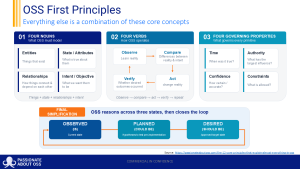
One of my favourite OSS books, that isn't an OSS book at all, is Insanely Simple: The Obsession That Drives Apple’s Success by Ken Segall Ken worked alongside Steve Jobs in the early days of Apple and cites many of the principles that drove its success. That triggered a thought: What are the core principles that underpin OSS/BSS? In most industries, including OSS, there are a million…

Read More »

Arnie, Danny and the Problem with Our OSS Digital Twins

We invest heavily in production environments (aka Arnie) and in reactive network fault-fix measures. Most OSS teams think of non-prod (aka Danny) as somewhere to test releases and patches. But if our non-prod environments were true digital twins of production, their value could be far greater. They could become environments where we simulate proposed changes, stress-test operational scenarios, validate interactions across domains and deliberately break things…

Read More »

Does Your OSS/BSS Have a Power-to-Weight Problem?

Telecom architects often jump to the conclusion that more capability means better performance. Add another feature, another platform, another integration, another automation layer and the system should become more powerful. But I wonder whether a Formula 1 engineer would immediately see that perspective as a problem rather than a solution? To an F1 engineer, it's more about reduction. More horsepower is useless if every improvement also…

Read More »

The Disposable Lighter has been Relentlessly Optimised. Has OSS/BSS?

As Daniel Priestley articulates well here, the disposable lighter is an extraordinary example of capitalism doing what capitalism does best - thousands of tiny improvements compounded over decades. A lighter can be manufactured, shipped and sold for almost nothing because decades of competition have relentlessly squeezed inefficiency out of the system. Yet OSS/BSS seems strangely resistant to the same market forces, despite competition across hundreds of…

Read More »

The Briefcase Technique: Making Your OSS Experiences Compound

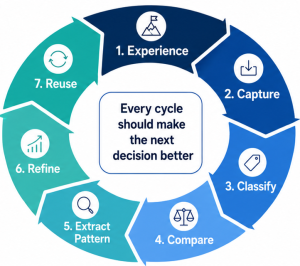
No two OSS projects are the same. One might have a different vendor stack, another a completely different organisational structure, another a different operating model or different vendors and architecture. But they don't need to be 100% identical to be repeatable and reusable. If 50% of the problem has appeared on one of your projects before, that's 50% you don't need to solve again from scratch.…

Read More »

The Age-Old IT vs OT Debate: Who gets the Keys to Your OSS?

For decades, organisations have argued over whether IT or operations (OT) teams should control the OSS environment, as though it’s a binary decision. Giving one team control of an OSS may appear to create clear accountability. But, like so much in OSS, the decision is far more nuanced. Ask who owns your OSS and you might hear the name of a department (though it might be…

Read More »

For the World Cup Final, will You replace Messi with a Local Club Player to lower wage costs?

Given the topical theme of the World Cup final, we'll go with a soccer story today. For the World Cup final, do you think Argentina ever considered replacing Messi with an attacking midfielder from a local Argentinian club simply because his wages are lower? Of course they wouldn't. Not because the local player is useless. Not because every role can/must be filled by a global superstar.…

Read More »

Entanglement vs Adaptability: The Decisions That Will Define the Future of Telco

For decades, scale gave large telcos purchasing power, infrastructure reach, extensive capability and millions of customers. It became one of the world’s most powerful and durable business models. But scale and complexity has created thousands of dependencies across OSS, BSS, networks, processes, vendors and people. Clay Christensen showed that disruption often begins with something that looks smaller, simpler and even inferior. Incumbents keep serving their best…

Read More »

What a Bali Market Taught me about OSS and Business

Success in business, distilled to its simplest form, is often about arbitrage. The gap between supply and demand. The gap between value delivered and value received in return. In the OSS industry, we tend to view arbitrage through a technical lens - better automation, AI, features, use cases, architecture and transformation. But a recent trip to South East Asia made me wonder whether one of the…

Read More »

When is an OOTB OSS Not Really Out of the Box?

When it comes to OSS, the term Out of the Box (or OOTB) can be correct, incorrect and highly confusing all at the same time. Buying an OOTB OSS is a bit like buying a suit off the rack. It exists. It has structure. It has the pockets, buttons, sleeves and lining you expected. But unless it is specifically tailored to the person wearing it, the…

Read More »

Knowledge Used to Be Power. In the AI Era, there’s a New Advantage

Since OSS were first built, they've been designed around the belief that more complete information creates better operations. That belief made sense when they were designed by Engineers for Engineers. When network, service, customer, inventory, topology and assurance data was scarce, fragmented and hard to access. The organisation with the best information usually had the advantage. If you could see more, correlate more and understand more,…

Read More »

What an OSS/BSS Procurement Really Costs: The Numbers Might Surprise You

An OSS/BSS transformation often begins with excitement and urgency due to a desperate need for change. It also creates trepidation because the wrong decision could shape the business for years to come. There’s no doubt that there’s a long list of things to work through, but that tension can lead to procurement events that could blow out past 18-24 months. Meanwhile, benefits are deferred and existing…

Read More »

How do you Tour the Most Beautiful Homes in the OSS Industry?

Daniel Priestley recently highlighted something as important for business owners as telcos seeking out their next OSS or BSS solution:"If I said to you, go and build your dream house, the first thing you'd do is imagine the finished product. You'd drive around beautiful neighbourhoods, look at the ones you wish you lived in, already finished, already done. You should be doing the same thing for…

Read More »

Lessons from a Solent University Project that gives me hope for OSS/BSS

Telco keeps worrying about a skills shortage. But a group of Solent University students just reminded me that the talent is still there. We just need to give them problems worth solving. That's why I wanted to take a moment to congratulate the Solent University team that recently developed an automated network prediction pipeline. Their project was designed to reduce some of the problems ISPs face…

Read More »

How rigorous OSS procurement can still get the transformation completely wrong

Most OSS experts focus on the implementation and post-go-live performance aspects of a transformation. That makes perfect sense, because they’re the most visible phases. But by the time implementation begins, many of the decisions that shape success or failure have already been set in place. The pre-implementation phase is often underestimated - treated as a vendor selection exercise - a period of requirements, demos, scorecards and…

Read More »

Ask for the Best OSS Vendor and You Start an Argument You Can’t Win

Everyone wants to know who the best OSS vendor is. But since there are 500+ OSS/BSS vendors, that question usually starts an argument, rather than the transformation you want to kick-start. The better question is which vendor best fits you best - your architecture, budget, maturity, constraints and operating model. PAOSS’s Inverted Pyramid approach starts with the broader OSS/BSS vendor landscape and filters quickly towards best-fit…

Read More »

Is telco facing a skills shortage… or a prestige shortage?

Telco keeps talking about being scared of an imminent skills cliff. But perhaps the real problem is not just that experienced people are leaving. It's that the industry has stopped feeling like the natural destination for the next generation of brilliant minds. Meanwhile, the industry’s hardest problems - automation, AI-native operations, complex transformation, data integrity, network / service resilience and complexity in general - are becoming…

Read More »

Phone books have disappeared, but telcos forgot why they mattered

Phone books now look like a relic from another era. Stone. Cold. Dead. But they were once one of the most powerful business growth engines in the world. Owned by telcos! As they declined in importance, Telcos didn't just lose a directory. They totally forgot they were matchmakers. Phone books were never just paper directories. They placed telcos at the heart of business discovery, trusted connections,…

Read More »