

Treating telco data quality like homelessness
In his book Upstream: The Quest to Solve Problems Before They Happen, Dan Heath tells a fascinating story about homelessness in Rockford, Illinois. For years,

When we find that orders have gone into (are about to go into) a jeopardy state or a fall-out state, the experts are brought in and tend to work backwards to identify the problem and resolve it.
But what if our OSS were able to predict the likelihood of future failure and present that information to operators? What if a certain series of similar steps / processes / values (the “recipe”) had resulted in a 90% fall-out rate based on analysis of past instances? Would the operator try a slightly different recipe to get a higher likelihood of success? Or if unable to change, then at least report that this recipe is likely to fail?
There are two numbers. The first is the likelihood of failure (ie fall-out). The second is the likelihood of reaching target SLAs (ie jeopardy), such as estimated RFS (Ready for Service) date.
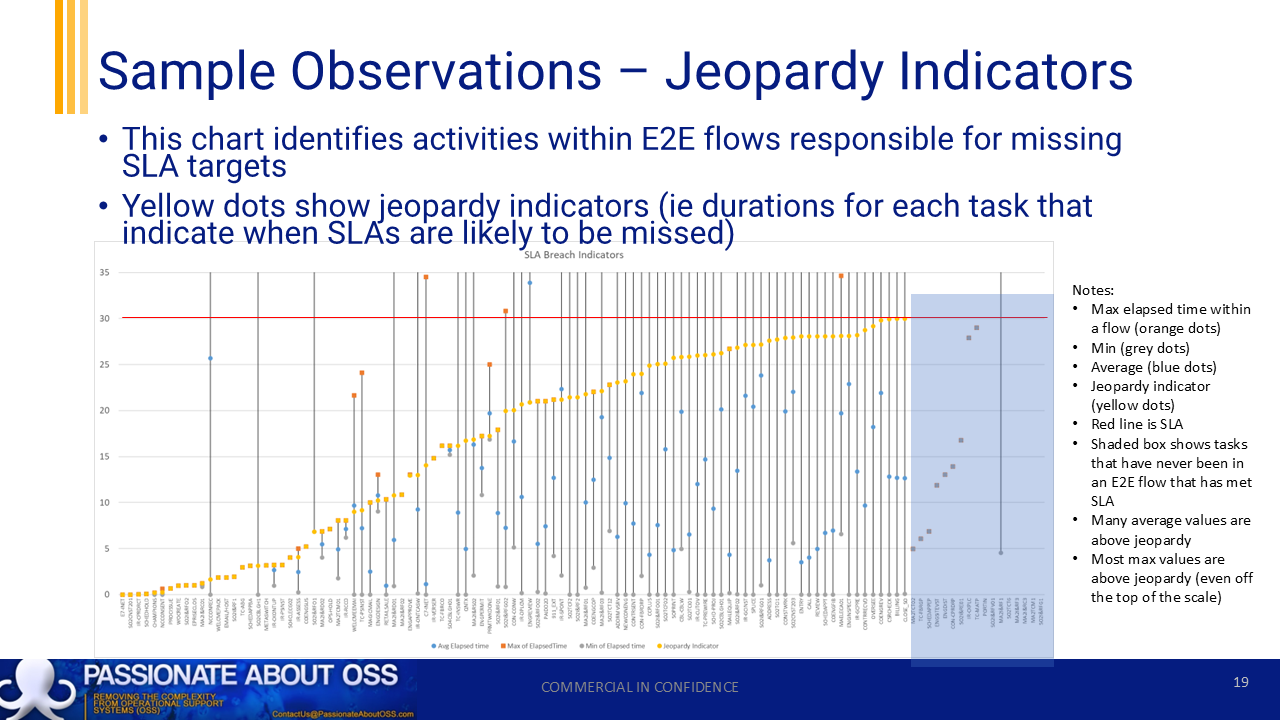
We’ve developed a way of predicting Jeopardy states on individual tasks on individual orders (as opposed to the order nearing a SLA breach date, by which time there’s often no possibility of recovery).
The diagram below shows
I’m sure these predictive stats are already being gathered by some sophisticated OSS. The difference here is in giving operators the information to improve the situation – at the front of the funnel, when there is still time to change, rather than mid-way through the work-flow when it’s nearer the bottleneck and deadlines are imminent.

In his book Upstream: The Quest to Solve Problems Before They Happen, Dan Heath tells a fascinating story about homelessness in Rockford, Illinois. For years,
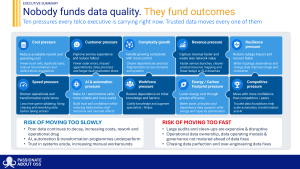
Imagine an apartment building with a leaking pipe. Multiple apartment owners keep paying to repair damaged ceilings, carpets and walls. But nobody wants to fund
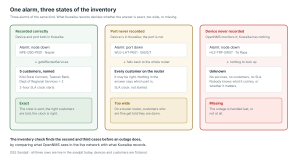
OSS Sandpit – Inventory Enrichment: Finding the Gaps Before an Outage Does Every inventory is out of date somewhere. A switch goes in during a
Bad OSS data has been quietly draining BAU budgets for decades. But with AI, AIOps and Autonomous Networking (AN), we’re about to discover just how