Description
Have you been handed the difficult task of making your organisation more autonomous?
Autonomous Networks can promise a compelling future: lower operating costs, faster service delivery, better customer experiences, improved resource utilisation, stronger resilience and new sources of revenue.
But the transformation is rarely as simple as adding more automation or deploying more AI.
Most telecommunications organisations already contain large amounts of automation. Network domains have closed loops. OSS platforms contain workflows and rules. Vendors are introducing copilots and agents. Business teams are experimenting with generative AI. Different groups may be solving legitimate local problems, but not necessarily working from the same enterprise strategy.
So autonomy can proliferate faster than the organisation’s architecture, governance and operating model can keep up
And that creates a new problem.
Today’s AI experiments can become tomorrow’s shadow IT: overlapping agents, duplicated capabilities, fragmented context, conflicting optimisation objectives, unclear accountability, additional integrations and years of avoidable total cost of ownership.
That is exactly the problem this guide is designed to help expose and address.
More automation is not automatically more value
Imagine one thermostat controlling a room.
It works perfectly well.
Now add another controller with a different target. Each controller can behave correctly on its own while the overall system oscillates and neither achieves the desired outcome.
Telecommunications operations increasingly face the same challenge.
Individual automation loops, AI models and agents can each optimise their own objectives while collectively producing complexity, conflict or unpredictable outcomes.
The answer is not simply more automation
It is the right autonomy, in the right places, coordinated around the right business outcomes
This guide provides a practical way to think about the transformation
The Autonomous Networks Strategy & Transformation Guide takes the reader through three levels of the problem.
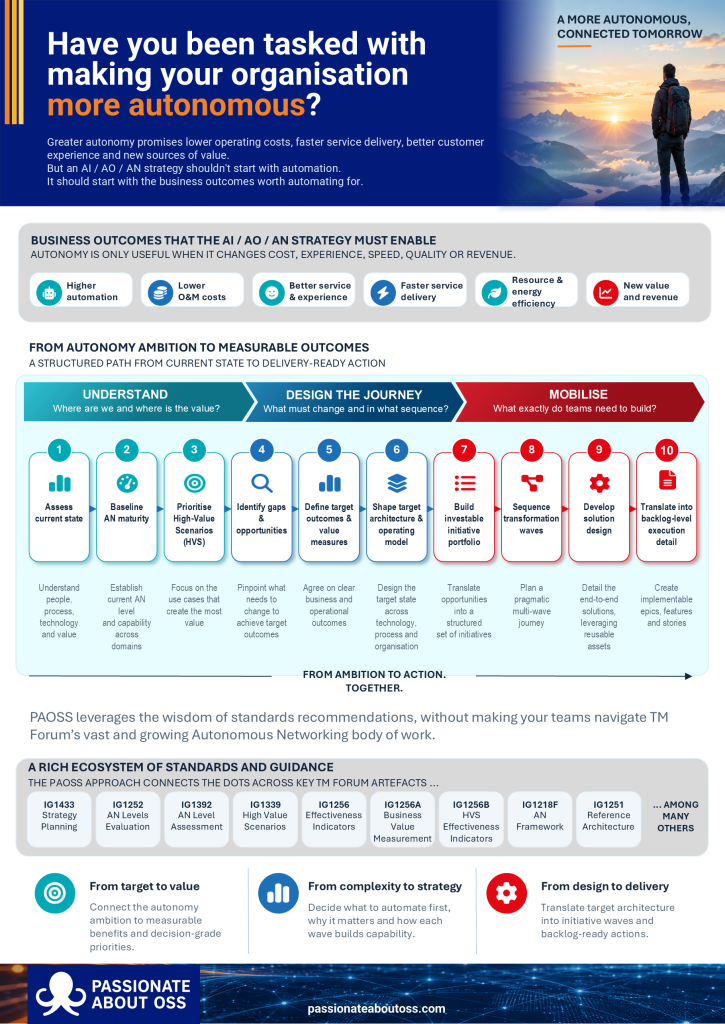
1. Understand the business case for autonomy
Start with the outcomes worth improving rather than the technology available to automate them:
- Improve customer centricity and service experience
- Reduce operating cost and repetitive manual intervention
- Accelerate service delivery and operational decision-making
- Improve network resilience, quality and recovery
- Increase resource and energy efficiency
- Create new opportunities for revenue, differentiation and monetisation
It also helps frame a critical question:
Should you transform enterprise-wide, or begin with one high-value problem where autonomy can make a measurable difference?
2. Turn ambition into a coherent transformation
The PAOSS methodology provides a structured path from current-state understanding through to executable delivery:
- Assess the current state
- Establish AN and AI governance maturity
- Prioritise High-Value Scenarios
- Identify capability, data and context gaps
- Define target business outcomes and value measures
- Shape target architecture and operating models
- Build an investable initiative portfolio
- Sequence transformation waves
- Develop solution designs
- Translate them into backlog-level implementation detail
The objective is to avoid an AN strategy becoming another high-level presentation that cannot be funded, sequenced or implemented.
3. Design the AI layer, governance and accountability
As autonomous decision-making increases, organisations need more than a network operating model.
They also need coherent data operations and AI operations
The guide introduces the relationship between:
Network operations
Who owns operational outcomes, delegation and escalation?
Data operations
Which sources own critical context and who is accountable for data quality?
AI operations
Which agent owns which decision, what may it do autonomously, when must humans intervene and how are actions governed and audited?
Together, these operating models help prevent individual automation initiatives from becoming disconnected islands of autonomy.
The guide also explains where AI fits across the transformation
AI should not appear as a standalone technology workstream after the AN strategy has already been defined.
It affects the transformation end to end, including:
- Inventorying existing models, agents and closed loops
- Assessing AI governance maturity
- Identifying high-value AI opportunities
- Understanding context, topology and knowledge requirements
- Defining trust, explainability and intervention measures
- Establishing delegation limits, guardrails and escalation paths
- Incorporating governance cost into initiative business cases
- Sequencing data and control foundations before scaling autonomy
- Designing agent patterns, auditability and intervention
- Embedding assurance and continual improvement into delivery backlogs
Built on industry guidance without making your teams navigate it all
PAOSS combines relevant industry approaches rather than treating Autonomous Networks as a single-standard problem.
The guide shows how the transformation can draw on:
- TM Forum Autonomous Networks for AN maturity, High-Value Scenarios, effectiveness measurement, architecture and implementation guidance
- ISO/IEC 42001 for organisational AI management, accountability, risk treatment and continual improvement
- NIST AI Risk Management Framework for governing, mapping, measuring and managing AI risk
- Australian AI guidance for practical governance, human oversight, transparency and responsible deployment
The objective is not standards compliance for its own sake.
It is to use the right guidance to make the transformation more coherent, governable and implementable
With this guide, you’ll get:
- A business-first way to frame Autonomous Networks rather than starting with technology
- A clearer view of where autonomy can create customer, efficiency, resilience and revenue benefits
- An explanation of why more automation can sometimes create more complexity
- The “thermostat problem” for understanding competing autonomous control loops
- A structured ten-step AN transformation methodology
- An AI overlay showing how governance and operating-model considerations affect every transformation stage
- A model for coordinating network, data and AI operations
- A pragmatic blend of TM Forum, ISO, NIST and AI-governance guidance
- A clearer path from executive mandate through to initiative portfolio, roadmap, solution design and backlog
This guide is especially useful if you are trying to:
- Build an enterprise-wide Autonomous Networks strategy
- Identify where AI and autonomy will generate the strongest business return
- Prioritise AN investment across competing opportunities
- Move beyond disconnected AI or automation pilots
- Prevent AI agents and copilots becoming the next generation of shadow IT
- Reduce future integration complexity and total cost of ownership
- Establish clear accountability for autonomous decisions
- Define an AI / AN operating model
- Develop a fundable AN transformation roadmap
- Align executives, network operations, architecture, data, AI and delivery teams
- Turn AN strategy into implementation-ready work
Why does this matter so much?
Because poorly coordinated autonomy does not remain a technology problem.
It compounds.
A locally successful AI agent can create another integration dependency. Another vendor platform can introduce another model and governance framework. Another closed loop can optimise a different objective. Another proof of concept can become another permanent piece of the operational estate.
Eventually, the organisation can find itself operating an increasingly expensive collection of autonomous capabilities without a coherent view of who owns them, how they interact, what value they create or how they should evolve
In other words:
AI is not automatically modernisation. Poorly planned AI can become legacy complexity remarkably quickly
The best time to design a coherent autonomy strategy is therefore before today’s experiments become tomorrow’s operational estate
The objective is not maximum autonomy
It is deciding:
- Where should autonomy create value?
- What should become autonomous first?
- How far should decision-making be delegated?
- What foundations need to exist before scaling?
- How should the entire system remain coherent as autonomy grows?
This guide provides a practical starting point for answering those questions.
Download the Autonomous Networks Strategy & Transformation Guide and give your organisation a clearer path from AI and autonomy ambition to measurable business value and executable transformation


Reviews
There are no reviews yet.