


In OSS, Why Do We Keep Choosing the Hard Life?
I’ve been trying to teach my kids a lesson lately that, if I’m honest, I’m probably not succeeding at (yet). Recently, it struck me that

Quants have become the rockstars of modern share trading – extracting powerful signals from oceans of data at near real-time speed. Trading firms invest billions in them and in infrastructure that will give them even the slightest timing edge. Yet while telcos drown in dashboards, the next competitive advantage may belong to the “NOC-star” – the Telco Quant.
Financial markets learned something critical decades ago: when information becomes abundant, the constraint shifts. It’s no longer access to data that determines success. It’s clarity of decision. Telcos and OSS designers haven’t fully learnt that lesson yet.
Digital operations are at the same inflection point today. Being brutally honest, they were probably at the same inflection point decades ago when trading houses first spotted the opportunity.
We’ll give you six reasons why we’re at an important cross-road today.
.
Telcos today capture everything. Network events, alarms, performance counters, customer interactions, billing anomalies, service degradations – nothing escapes instrumentation (well, almost nothing, but I digress for now).
Have you noticed that prodigiously more data and visibility has not translated into better decisions?
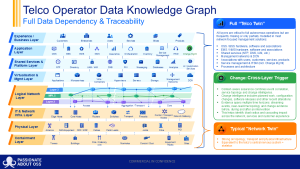
Dashboards have multiplied. Metrics and KPIs have proliferated. We’ve developed data swamps where data sits in silos across network / resources, product, operations, finance, lead-gen, etc (see diagram below).

And when high-magnitude, company-wide decisions must be made – infrastructure investments, vendor selections, transformation commitments – the decision-making clarity is simply not there. It takes more work, more data collection / aggregation, more waffle… and then best-guesses are often employed.
Share trading firms have long faced similar data abundance such as ticker prices, investor reports and much more. But they solved it differently. They’ve used quants to combine dozens of signals across domains into probabilistic models that identify clear, actionable patterns. When they make large bets, they do so on statistically validated signals.
Telcos, by contrast, too often make large bets on executive instinct, vendor persuasion or political momentum.
Surely that constraint has shifted now? Generative AI has just accelerated the trend. The scarce resource is not data. It is decision clarity (picking the signal from the overwhelming noise).
.
A Quant is not simply a mathematician in finance. A Quant is a decision architect.
Their job isn’t prediction as such. It’s testing hypotheses. They fuse historical datasets with signals hitting the wire in real time. They build what-if models. They frame uncertainty in measurable terms. They express confidence as probability, not persuasion.
If we’re being honest here, you could probably argue that telcos have too. Perhaps not to the same extent.
But where the two diverge critically is that trading houses have learned to trust this discipline. Portfolio managers routinely defer to model-backed evidence. Massive amounts of capital is deployed instantaneously because the probabilistic case is strong, not because a senior voice in the room feels confident.
In many telcos, however, data still supports arguments rather than drives them. Models are often retrospective – used to justify decisions already taken. The Trusted Telco Quant (TTQ), if such a person exists, inverts this. Evidence precedes commitment.
“The noise” (ie telemetry) is all there at the fingertips of each telco because of the collectors built for our OSS/BSS. Networks are now dynamically engineered at millisecond speeds.
It’s the “signal identification” that’s missing. As a result, decision cycles still take weeks and hunches.
More data is collected and collated. Committees debate. Slide decks are polished and circulated. Opinions waver. Meanwhile, operational conditions evolve in real time and the opportunity has likely already past.
In trading, decision latency is almost immediate. If a model signals opportunity, action follows algorithmically. The infrastructure exists to support rapid, evidence-backed execution. The speed of that decision is critically important for a competitive advantage over other high-speed trading houses.
In share trading, arbitrage is fleeting, so speed of decision-making is essential. But, I’d also argue that opportunity arbitrage is inexorably trending downwards in telco also. Having an OSS/BSS stack that’s built for speed of flexibility is already an advantage but will become even more so in future.
In telecoms, we have reduced system latency but left decision latency largely untouched. In fact, I’m openly wondering whether the reduction in system latency (and proliferation of data that follows) has actually slowed decision latency.
Let’s be clear – a Telco Quant mindset already recognises that slow decision-clarity costs far more than slow compute. The divergence will surely increase in future.
.
Transformation roadmaps represent billions in capex and opex. They reshape operating models and lock organisations into multi-year trajectories.
Yet many programmes are still driven by hierarchy, influence and vendor narratives. Scenario modelling is thin. Probabilistic comparison between alternatives is rare.
What-if modelling should precede every major commitment. Historical performance data combined with live operational feeds can simulate impact. Trade-offs can be quantified. Risk exposure can be framed explicitly.
This is not financial investing. It is strategic resource commitment – people, time, engineering effort, political capital.
Quants make bets only when signal strength crosses a defined threshold. Telcos should do the same before committing to transformative change.
.
If the Telco Quant is to emerge, the our tooling must evolve. Today’s OSS environments are already exceptional at data collection.
What they’re far less mature at is clarity of next action, probabilistic modelling, cross-domain synthesis and scenario simulation.
UI design is dashboard-centric rather than decision-centric. How many times have you seen performance management tools with hundreds of dashboards, but no indication of what’s inside / outside expected behaviour? Workflows optimise ticket closure rather than strategic clarity. Operators are trained as responders, not probabilistic thinkers.
This is where OSS tools have a decisive role to play. They must:
The NOC operator of the future is not just a monitor. Armed with advanced probabilistic signal monitoring, they’re a NOC-star.
.
In trading, infrastructure spend is justified by marginal advantage. Billions are invested to gain microseconds because models prove that this infinitesimal arbitrage matters.
Telcos also deploy enormous capital – spectrum, fibre, data centres, platforms, transformation initiatives. But without elaborate, disciplined modelling, capital allocation becomes uneven. Local teams optimise their own KPIs while executives make enterprise-wide commitments without unified confidence metrics. At any point in time, a large telco has hundreds of decisions to make in relation to networks and services. Where to augment, where to replace, where to obsolete, where to assign additional resources, which problems to prioritise. The list is endless. Each of these decisions tend to be made in isolation (domain-by-domain, siloed-dataset-by-dataset).
What the telcos are finding, on the back of the industry getting somewhat less sexy to investors, is that capital is finite. CAPEX is constrained. OPEX is constrained. Transformation budgets are political. Moreover, sub-optimally allocated budgets and effort compounds over years.
The Telco Quant introduces a capital discipline grounded in evidence. Cross-domain modelling produces a clearer view of expected return – not only financially, but operationally and strategically. The result is not just safer decisions. It is smarter, faster, better deployment of their most finite resources.
.
High-frequency trading didn’t succeed because it collected more data. It succeeded because it refined decision making and found a way to trust those decisions. Trust shifted the profile of decision-making from instinct to evidence. From hierarchy to probability. From narrative to model. From instinctual guessing to immediate allocation of capital.
Telecoms now stand at a similar crossroads.
All of the pieces are in place. We have abundant data. Powerful infrastructure. Connected ecosystems. Regulated environments where mistakes are costly.
What we lack is clarity at the moment of commitment. This isn’t just a human-factor problem, but an opportunity for improvement in the systems we design and build.
As far as I know, the Trusted Telco Quant (TTQ) isn’t a job title yet. We have Chief Data Officers (CDOs), but their decisions are rarely backed by massive deployment of capital without overwhelming executive guard-rails (rightly so, one could easily argue).
When that shift happens, and it will eventually, the NOC will no longer be a room full of dashboards.
Our NOC-stars will have the tools that allow them to see the signal clearly enough to act with confidence. The TTQs will have tried and tested the tools that they put in the hands of the NOC-stars.
what does this look like? Perhaps this Rolls-Royce’s vision of an OSS-like solution might give you some hints.

I’ve been trying to teach my kids a lesson lately that, if I’m honest, I’m probably not succeeding at (yet). Recently, it struck me that
The previous article highlighted how my chiropractor taught me something I didn’t realise about telecoms. It then triggered another image in my head (the first
Telco orders are a lot like falling in love. But, just like a Hollywood rom-com, there are always hilarious twists, awkward misunderstandings, hot exes and

I recently went to my chiropractor with wrist pain. I assumed it was from years of playing tennis and typing on keyboards. That seemed fairly