Frustrated that every data clean-up seems to end with the same problems coming back?
Your network, automation and AI ambitions depend on trustworthy operational data.
But the biggest cost isn’t necessarily the bad records themselves. It’s the recurring failures, workarounds and operational waste they create across your business.
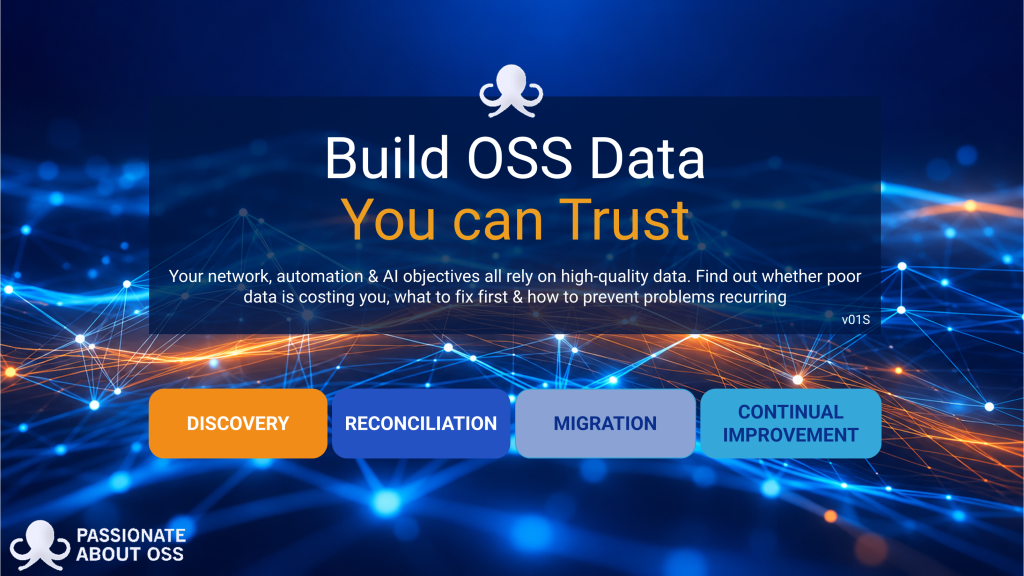
Build OSS Data You Can Trust provides a practical, experience-based methodology for discovering data problems, identifying which ones cost you the most and establishing systematic processes to stop them recurring.
Inside, you’ll discover:
A six-stage methodology for building and sustaining trusted operational data
14 laws of data integrity and a practical data-fix playbook
How to discover, reconcile, migrate and federate complex network data
How to establish a Data Integrity Control Tower and Data Operations Centre (DOC)
How AI, automation and Digital Twins can accelerate data improvement
Five practical implementation patterns with interactive work breakdown structures
Built on experience from approximately 100 telecommunications projects, not just theory.
Get the Data Foundations pack by clicking on the “Add to Cart” button to your right
(see below for further details about what’s inside)
Stop paying for the same bad data problems over and over again.
A practical, 94-page interactive guide to discovering, fixing and preventing costly telecommunications data problems.
How much is bad data really costing your organisation?
Have you ever invested in cleaning up your network data, only to discover the same problems creeping back months later?
Perhaps you’ve migrated to a new inventory system, implemented automated discovery, reconciled millions of records or commissioned expensive field audits.
The data looked better. The project was declared successful.
And now you’re considering another clean-up project.
Or perhaps you’ve been tasked with allocating your organisation’s AI and/or Autonomous Networking (AN) budget and already know that you need to get your source data sorted out first?
What if the biggest problem isn’t the quality of your data?
What if it’s the lack of a systematic way to stop that data deteriorating again?
That’s the problem this guide is designed to help you solve.
Bad data isn’t free. You’re already paying for it.
The true cost of poor network data rarely appears as a line item on an executive dashboard.
Instead, it’s buried in everyday operational (BAU) activities:
Technicians returning to sites because the recorded network doesn’t match reality
Orders failing because inventory and provisioning systems disagree
Engineers manually tracing service paths that should already be known
Incorrect fault-impact assessments that delay restoration or misidentify affected customers
Repeated reconciliation between systems that should be synchronised
Network assets sitting unused because their existence, location or availability is uncertain
Brand new AI and automation initiatives that can’t be trusted because of the underlying information
These aren’t necessarily independent problems.
One defective data record can create multiple failures across interconnected systems and processes.
For example, consider an illustrative case involving incomplete fibre splice records:
Avoidable consequence
Illustrative annual cost
Repeat truck rolls
$78,000
Design rework
$40,000
Order fallout
$20,000
Total recurring leakage
$138,000
Halving these recurring problems could avoid $69,000 per year, from just one defect family.
Now imagine identifying and addressing the most expensive recurring defects across your wider network and OSS/BSS environment.
Note: The figures above are an illustrative example from the pack, not a guaranteed saving or reported customer outcome.
The real question isn’t whether you can afford to improve data quality. It’s how much you’re already spending by allowing the same defects to return over and over again.
Why do so many data improvement programmes fail to deliver lasting results?
Traditional data projects tend to concentrate on a specific outcome:
Conduct an expensive one-off audit, then cleanse the inventory before a migration
Reconcile the network before a new OSS implementation
Audit network assets before a major transformation
Consolidate records into a new system of record
Introduce discovery tools to collect more accurate information
Each can be useful but they often share one fundamental weakness:
They focus on correcting existing data rather than systematically preventing new defects from being created.
The underlying causes remain: inconsistent naming, incomplete change processes, unclear ownership, faulty collectors, broken interfaces, outdated models and weak governance.
As a result, the data begins deteriorating again.
We call this the Data Death Spiral.
Poor data causes unreliable processes. Unreliable processes lead to poor decisions and workarounds. Confidence falls, investment becomes harder to justify and data quality deteriorates further.
And the cycle repeats.
The alternative is to build a continual data improvement capability, where every detected defect becomes an opportunity to improve the underlying data, rules, processes and operational controls.
Stop treating data quality as a project with an end date. Start treating it as an operational capability that gets better over time and gives your organisation a competitive advantage (because you know all your competitors’ data sets are compromised too).
Imagine if your data became more trustworthy every day
Picture an operating environment where:
Your network inventory reflects operational reality. Network assets, topology, service relationships and dependencies can be validated against reliable evidence rather than accepted on assumption.
Your teams spend less time investigating avoidable problems. Recurring defects are identified, prioritised and corrected at their source instead of being repeatedly worked around.
Your service delivery processes become more dependable. Fulfilment, assurance, planning and change processes work from more consistent and trustworthy information.
Your data problems become visible and manageable. Instead of scattered spreadsheets and undocumented fixes, you have measurable data quality, accountable owners and a systematic resolution process.
Your AI and automation initiatives have a stronger learning and inferencing foundation. Systems can make recommendations and take authorised actions using data with known provenance, confidence and operational context.
Your improvements don’t disappear when the project team leaves. Data integrity becomes part of everyday operations, with processes that continually detect deterioration and prevent recurrence.
These are the outcomes Build OSS Data You Can Trust is designed to help you work towards.
The goal isn’t perfect data everywhere.
It’s building data you can trust for the decisions that matter, maintained at a cost that makes commercial sense.
Introducing Build OSS Data You Can Trust
A practical, 94-page interactive guide from Passionate About OSS (PAOSS), bringing together telecommunications data modelling, discovery, reconciliation, migration, governance and continual improvement into one integrated methodology.
Built on PAOSS experience across approximately 100 projects, hundreds of networks, millions of records and thousands of devices, it combines field-tested concepts with emerging technologies and practical implementation approaches.
Rather than telling you simply to improve your data quality, it helps answer six important questions:
What do we actually know about our data today?
What should our trusted data model look like?
Which defects should we fix first, and how?
How should we discover, reconcile, migrate and control information?
How do we systematically detect and resolve data faults?
How do we ensure improvements keep delivering value?
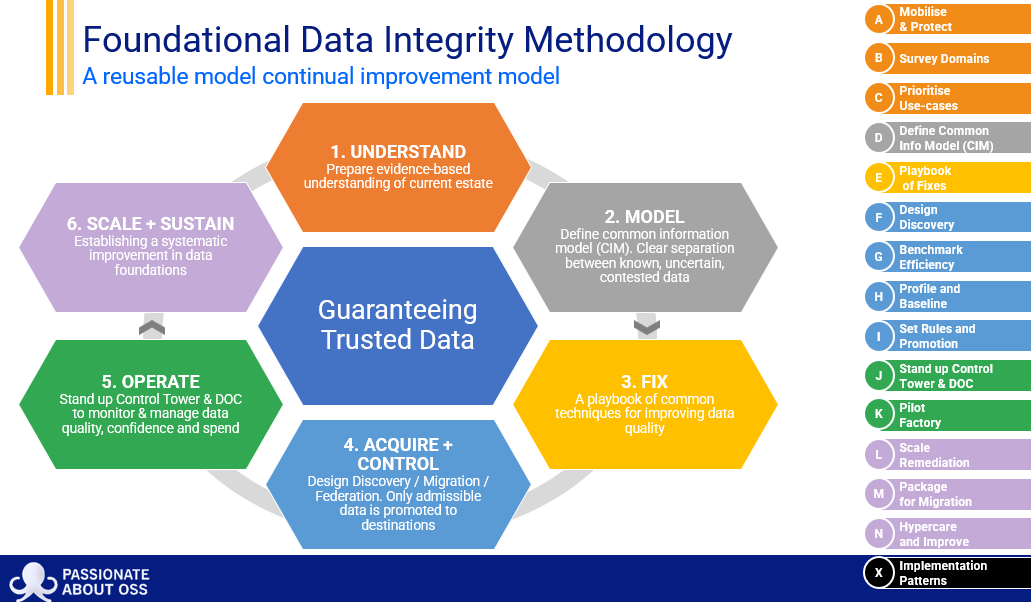
These six questions form the foundation of the PAOSS Data Integrity Methodology.
Six stages for building and sustaining trusted data:
1. UNDERSTAND: Find out where you stand
Build an evidence-based understanding of your existing network and data estate.
Map systems, domains, ownership, data quality, operational dependencies and the defects causing the greatest impact.
2. MODEL: Define what trustworthy data looks like
Establish the Common Information Model (CIM), identifiers, relationships, source authority, lifecycle rules and confidence requirements.
Design a coherent view of the network without necessarily forcing every domain into one system.
3. FIX: Address causes, not just symptoms
Apply a practical playbook of remediation techniques.
Prioritise recurring defect patterns, repair data relationships, use automated rules where possible and involve AI or human expertise where uncertainty remains.
4. ACQUIRE + CONTROL: Collect and promote data safely
Design discovery, reconciliation, migration and federation processes.
Use validation, confidence scoring, provenance and controlled promotion so questionable data doesn’t automatically become operational truth.
5. OPERATE: Manage data faults systematically
Establish a Data Integrity Control Tower and Data Operations Centre (DOC).
Measure data health, detect problems, coordinate accountable owners, verify corrections and track prevention.
6. SCALE + SUSTAIN: Turn improvement into business as usual
Start with a representative pilot. Prove the approach. Industrialise successful fixes and expand across additional network domains and data sets.
The objective is a repeatable capability that continues delivering benefits long after the initial project finishes.
Treat data faults like network faults
One of the most important concepts in this guide is surprisingly simple.
Your Network Operations Centre systematically manages network faults. Why not manage data faults with the same discipline?
Most operators have mature procedures for detecting, escalating, investigating, resolving and preventing network incidents.
But data faults are often managed through ad hoc spreadsheets, manual corrections, email exchanges or the knowledge of a handful of specialists.
The guide introduces two complementary capabilities to change this.
The Data Integrity Control Tower (CT)
Know where the problems are.
The Control Tower continually measures the health of your operational data.
It helps you:
Monitor completeness, consistency, confidence, freshness and drift
Detect conflicting records, missing relationships and recurring defects
Visualise data quality through confidence heatmaps and scorecards
Identify high-impact data problems before they cause further operational harm
Track whether remediation is producing sustained improvements
The Data Operations Centre (DOC)
Fix the problems and prevent them coming back.
The DOC provides the operational discipline to manage data defects from detection through to verified resolution and prevention.
It helps coordinate:
Data fault classification and triage
Assignment to accountable source owners and resolver teams
Automated, AI-assisted and human-led investigation
Corrective actions, verification and closure
Root-cause analysis and preventive improvements
Together, the Control Tower and DOC create a model for systematic, closed-loop data improvement.
The Control Tower sees the problems. The DOC acts on them.
And the teams responsible for the source systems remain accountable for correcting data at its origin.
What’s inside the guide?
The interactive pack is organised around practical concepts, implementation techniques and operational models.
Build the foundations properly
Explore the 12 core OSS data concepts and 14 laws of data integrity.
Understand why seemingly minor data defects can compound into major end-to-end failures, why provenance matters and why data quality must be judged against its intended operational purpose.
Learn how to model network information in logical layers, establish common identifiers and stitch relationships across network domains, services, assets and customers.
Design better data architectures
Understand when to consolidate, federate, synchronise, mediate, propagate or reference data across multiple systems.
Explore Common Information Models, knowledge graphs, network topology, data ownership and cross-domain integration.
Discover why a coherent operational view doesn’t necessarily require replacing every existing inventory system.
Discover, reconcile and migrate with confidence
Examine practical approaches for collecting data from network devices, EMS/NMS platforms, OSS/BSS applications, GIS, supplier systems and other sources.
Learn how to:
Catalogue northbound interfaces and identify access constraints
Benchmark discovery performance and identify bottlenecks
Reconcile conflicting data using source precedence and evidence
Manage migration, validation, exceptions and rollback
Distinguish verified, inferred, contested and quarantined information
Build the foundational data estate in a logical sequence
Build a repeatable playbook of fixes
Learn why correcting individual records is rarely sufficient.
Understand how to classify defect types, prioritise them by business impact and group related issues into repeatable remediation waves.
Explore the combination of deterministic rules, AI-assisted investigation, field verification and process improvements.
Establish continual data improvement
Design the operating processes that allow data quality to improve instead of decay.
Explore:
Control Tower and DOC operating models
Data fault lifecycles, classification and resolution routes
Confidence maps and operational dashboards
Data integrity and business outcome KPIs
Pilot reconciliation factories
Remediation waves, controlled releases and hypercare
Governance, accountability and long-term stewardship
Prepare for the next generation of OSS and AI
Investigate six emerging opportunities for strengthening data foundations:
Graph-native network integrity
Digital Twins as validation gates
Agentic stewardship
MCP-based operational tool access, including MCP-T concepts
Machine-executable trust and governance
Confidence-aware operational data
Understand how these capabilities could support increasingly autonomous network operations without allowing uncertainty to propagate unchecked.
Five practical ways to get started
You don’t have to commit to a massive transformation programme to benefit from the methodology.
The pack includes five implementation patterns, each linking to an interactive Work Breakdown Structure (WBS) covering activities, deliverables, milestones, dependencies and indicative RACI assignments.
Choose the approach that matches your situation.
Implementation pattern
What you’re trying to achieve
1. Federated network inventory and integrity uplift
Connect existing systems into a coherent operational view, then improve integrity domain by domain
2. Data integrity uplift without dedicated funding
Start fixing recurring defects using existing teams, tools and business-as-usual activities
3. Funded data integrity uplift
Accelerate discovery, reconciliation, remediation and preventative controls
4. Data Integrity Control Tower and DOC
Establish a dedicated capability to detect, prioritise, resolve and prevent data faults
5. Inventory and data foundations roadmap
Assess the current estate, define the target and plan investments, dependencies and implementation waves
Each provides a starting structure that can be tailored to different networks, funding levels, maturity and operational priorities.
Not sure which option is right? Start with the problem costing you the most.
“This sounds useful, but…”
We don’t have a budget for another data programme
You don’t necessarily need one to begin.
The guide shows how to start with an impact audit, a basic data quality dashboard and a systematic defect-resolution process using existing resources.
Measure the avoided costs from one successful fix, then use that evidence to support further investment.
Let each improvement help justify the next.
Our network and data environment are too complex
That’s exactly why the methodology recommends starting with bounded, representative domains and working incrementally.
Model one domain. Reconcile its internal relationships. Stitch it to the next. Expand the shared view as confidence grows.
You don’t need to solve every data problem before delivering your first improvement.
We’ve already invested in discovery and data governance tools
This methodology doesn’t assume you need to replace them.
It helps you understand what your existing tools can do, where their gaps lie and how to integrate them into a more systematic operating model.
The focus is on improving the effectiveness of what you already have before introducing unnecessary complexity.
We don’t need perfect data everywhere
Agreed.
The guide introduces Minimum Viable Data (MVD) and fitness-for-purpose principles.
Not every record needs the same level of accuracy, confidence or freshness.
Focus investment on the data that supports your most important operational decisions and business outcomes.
Isn’t this just another theoretical whitepaper?
The pack combines practical telecom experience with worked examples, architectural patterns, remediation methods, KPIs and five implementation planning structures.
It’s designed as an interactive reference that you can use when evaluating options, designing projects, challenging assumptions or preparing your own implementation approach.
It’s not a substitute for validating the details against your environment. It’s a way to make that process more structured and evidence-based.
Who is this guide for?
Telecommunications executives and transformation sponsors looking to reduce avoidable operational cost, improve service outcomes and justify data-related investment
OSS/BSS and network architects responsible for inventory, service models, network data, federation, integration and migration strategies
Network operations and assurance leaders seeking better data confidence, more accurate service impact and fewer recurring operational problems
Data governance, engineering and migration teams implementing data quality controls, reconciliation, discovery and continuous improvement
AI, AIOps and Autonomous Networking programme leaders preparing reliable operational data for increasingly autonomous systems
Systems integrators and technology vendors developing or delivering network and OSS/BSS transformation programmes
Your first improvement can start with one defect
You don’t have to solve your entire data estate.
Start with three simple actions.
1. FIND THE LEAKAGE
Identify recurring operational costs caused by unreliable data. Look at truck rolls, order fallout, design rework, incidents and manual reconciliation.
2. TARGET THE ROOT CAUSE
Select a high-impact defect family and identify the underlying issue that’s allowing it to recur.
3. PROVE THE FIX
Pilot a systematic fix. Measure the impact. Verify whether the defects stop returning and decide where to expand next.
That first result can become the evidence for a larger data improvement programme.
And if you’re ready to accelerate, PAOSS can help with assessing your current data estate, establishing priorities, designing the target operating model and planning the implementation.
Stop cleaning the same data. Start preventing the problems.
Your AI, automation, network assurance and transformation ambitions all depend on trustworthy data.
But you don’t need to begin with the biggest possible data programme.
You need to begin with the most valuable problem you can solve, establish a systematic fix and make sure the improvement lasts.
Build OSS Data You Can Trust gives you a practical methodology for doing exactly that.
Get the guide. Find the leakage. Fix what matters. Keep it fixed.
Get the Data Foundations pack by clicking on the “Add to Cart” button above
And if you’d like to discuss your data integrity priorities with PAOSS, feel free to contact us.
Reviews
There are no reviews yet.
Be the first to review “Build OSS Data You Can Trust (digital whitepaper)”



Reviews
There are no reviews yet.