

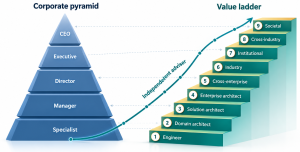
Are you climbing the corporate ladder or the value ladder?
Have you ever looked at the next rung of the corporate ladder and wondered whether that’s actually a job you’d want to do? When I

Telco keeps talking about being scared of an imminent skills cliff.
But perhaps the real problem is not just that experienced people are leaving. It’s that the industry has stopped feeling like the natural destination for the next generation of brilliant minds.
Meanwhile, the industry’s hardest problems – automation, AI-native operations, complex transformation, data integrity, network / service resilience and complexity in general – are becoming more demanding, not less.
A recent conversation with a friend about Singapore’s President’s Scholars programme (which I’d never previously heard about) sparked a thought experiment. Could telco build a similar prestige pathway? A pathway that makes telco exciting again for some of the world’s brightest minds – then apprentices them out to learn how to solve the global industry’s hardest shared problems.
.
There was a time when telecommunications was THE world’s most innovative industry. Perhaps the most innovative period in the world’s history.
In those days telcos did a lot of R&D, including the invention of OSS/BSS and even the programming languages that were used to build them. Check out the book, “The Idea Factory: Bell Labs and the Great Age of American Innovation” by Jon Gertner (read more about it here – https://passionateaboutoss.com/an-uncommon-list-of-oss-books).
This is the most inspiring book I’ve read in relation to the communications industry. The groundbreaking innovations that were developed within R&D powerhouses like Bell Labs during the 1900’s are staggering and something that we can barely even aspire to today. British Telecom and many other government-owned telcos, including Telstra’s R&D Labs here in Australia, also did amazing primary research. But they all offloaded that R&D responsibility to the vendors and to the standards bodies to a lesser extent many years ago.
The telco industry connected continents. It compressed distance. It made mobile computing possible. It created the building blocks on which the internet, cloud, smartphones and digital economies now run.
But somehow, telco has become less visible in the imagination of many brilliant young people. The excitement has migrated elsewhere – to hyperscalers, AI, cyber, cloud, robotics, fintech, space-tech and start-ups.
That’s a problem.
Not because telco lacks smart people. It still has plenty.
But a large percentage of the industry’s deep experts are of a previous generation – approaching retirement, have already retired, or have moved into adjacent fields.
So perhaps the industry’s problem is not just a skills shortage but a prestige shortage?
Telco needs a new story. Not “come and maintain yesterday’s infrastructure with shrinking budgets and head-count”, but “come and build the most important machine that exists in the world today” (ie the global telco network).
.
Singapore’s President’s Scholars programme is interesting because it represents more than academic excellence. It symbolises prestige, built around systematic public purpose and leadership development.
The very best aspire to be President’s Scholars.
The telco industry doesn’t come close to copying that model. For a start, it’s not a nation state. It can’t bond people to public service in the same way. It also shouldn’t fall into the trap of selecting only polished academic elites.
But it can borrow the deeper objective: create a deliberate supply chain of brilliant telco leadership.
Imagine a Global Telco Fellows programme that identifies exceptional people at multiple entry points. Some might be university students. Some might be vocational learners. Some might already be NOC engineers, OSS analysts, fibre planners, field supervisors, automation developers, product owners or data specialists who have never been labelled “elite”, but clearly see patterns others miss.
The selection criteria would need to be broader than grades. Telco needs lateral thinkers. People with curiosity, resilience, humility, technical range, public-interest instincts and the ability to operate under stress across ambiguity.
The aim would not be to create corporate stars.
It would be to create leaders who can serve every facet of the global telco ecosystem. Not just tech leaders. Clearly not just that!!
.
Firstly, what is NONA? It’s the Network Operations Ninja Academy, but it clearly goes beyond just network operations. It talks about a very different type of learning, for a very different operational environment than exists today.
Network operations is changing. AI, automation, cloud-native networks, software-defined infrastructure and autonomous assurance are reshaping what operators do. They’re changing the constraints around which the telco industry, networks and services were once designed.
Routine tasks may disappear. New opportunities (and challenges) will appear.
But exceptional judgement becomes more important than ever.
The danger is that automation removes many of the old apprenticeship pathways. How do you build experience if AI handles all of the experiences?
In the past, people learned by doing at scale – fixing faults, reconciling problematic data records, adapting to different customer order needs, handling angry customers and discovering why the real network didn’t match the design documents.
If AI takes over too many of the basics, where do future experts get their expertise?
NONA could become just one part of a very deliberate answer. A simulation-rich academy where fellows practise the scenarios and crises before they encounter them in the wild.
NONA graduates would work through the most challenging scenarios – technology upheavals, competitive fractures, network outage war gaming, global-scale cyber or runaway-train incidents, major event preparation, changing customer needs and executive crisis briefings.
They would learn how all of the pieces of OSS and BSS (assurance, orchestration, field operations, regulation, cyber, cloud, AI, and more) underpin network resilience, customer experience and commercial trade-offs as one connected system. But also provide all the intelligence gathering pathways from which informed executive decision-making is made.

That is the shift: network operations stops being treated as a back-office function and becomes an elite systems-leadership pathway.
.
This is actually the question I found hardest to answer in this thought experiment. Ownership.
If one operator owns the programme, it becomes a graduate scheme. No single vendor or integrator could own it. If one country owns it, it becomes a regional talent pool.
The telco industry needs something more neutral. Something more global.
A credible model would need shared governance across operators, vendors, integrators, regulators, universities, industry bodies and independent experts. It could have regional nodes for local relevance, but global missions for shared value.
And once the model is identified, how is the programme funded?
Sponsors should receive benefits: early access to fellows, influence over mission themes, visibility into emerging talent, and access to reusable outputs. But they should not own the talent exclusively.
The global problems facing telco are too large to be solved by isolated corporate leadership pipelines.
So, that prompts the next question.
.
If the industry created such a programme, it should not waste the talent on small problems (although there’s clearly an apprenticeship phase as no global leader is developed in a vacuum).
Yes, fellows could help with solving inventory mismatches, OSS/BSS transformation simplification, network faults and assurance, procurement reform and the like. Those are important. They are the practical foundations on which better telco outcomes depend.
But the programme should aim higher:
One cohort might be apprenticed out in a variety of countries and business units to explore new models for subscriber value beyond connectivity. Another might design communications-enabled services for ageing populations, disaster response or remote education. Another might tackle why telco partnerships with vertical industries so often stall. Another might build reusable frameworks for trustworthy data, AI-era assurance or outcome-based vendor engagement.
The point is to build a problem-solving machine that happens to develop extraordinary leaders with a diversity of thoughts and experiences. Each must be capable of seeking the greater good by looking beyond a single domain (where every head of department tends to have a different perspective of what the telco’s measures of success are).
That may be the most important lesson from the President’s Scholars thought experiment. Prestige is not created by calling something elite. It’s created by proof that arises from giving exceptional people difficult missions, structured development, high expectations and a purpose bigger than themselves.
Telco changed the world by connecting it.
It feels to me like the next step is to attract the people who can help it matter just as much again.

Have you ever looked at the next rung of the corporate ladder and wondered whether that’s actually a job you’d want to do? When I
OSS Sandpit – Hidden Single Points of Failure: Routes That Look Diverse but Aren’t Ask any network planner whether their important sites are protected and
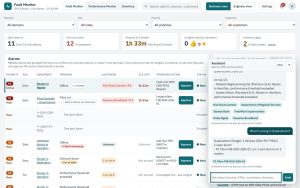
Every NOC has lived this moment. The alarm list lights up, dozens of red rows appear at once, and the first question from the duty

Across this series, we’ve looked at fragmented AI investment, the rush to launch AI projects, the AI dependence on OSS and BSS, and the need