

When is an OOTB OSS Not Really Out of the Box?
When it comes to OSS, the term Out of the Box (or OOTB) can be correct, incorrect and highly confusing all at the same time.


Everyone wants to know who the best OSS vendor is.
But since there are 500+ OSS/BSS vendors, that question usually starts an argument, rather than the transformation you want to kick-start.
The better question is which vendor best fits you best – your architecture, budget, maturity, constraints and operating model. PAOSS’s Inverted Pyramid approach starts with the broader OSS/BSS vendor landscape and filters quickly towards best-fit options, rather than assuming the answer starts with the handful of vendors you’re familiar with.
Let’s face it. OSS transformations are often large and complex projects.
The typical long RFx can feel safer because of its rigour.
But in OSS, more documents, more requirements and more vendor responses generally just creates more fog.
The smarter path is to filter more specifically and faster, removing low-fit solutions, then evaluate deeper on the few that remain.
.
It would be great if there were one or two clear “best” OSS/BSS solutions. But in reality, if you ask ten OSS people for the best vendor, you’ll almost certainly get ten different answers.
Chances are, they’ll even give you products from different functional categories.
That doesn’t mean they’re wrong. It just means they’re answering from their own context.
One person may love a vendor because it worked brilliantly in a previous inventory transformation. Another may avoid the same vendor because it struggled in a heavily customised assurance environment. A third may recommend a platform because the demo was impressive, the roadmap looked strong or the vendor’s delivery team never quite found the right way to work with the client’s stakeholders.
That’s the problem with “best”. It’s too subjective.
In fact, the reason we created the Blue Book OSS/BSS Vendor Directory of 500+ vendors was because one of our clients asked us to bring them “the top-right corner of Gartner.” The only problem was the top right corner of Gartner wasn’t well suited to this client at all.
“Best” is subjective. Fit is different. Fit can be tested.
You can test how closely a vendor / product already aligns with your functional needs. You can test whether its architecture works with your integration patterns. You can test whether its implementation model suits your internal capacity. You can test whether its commercial model fits your budget and risk appetite. You can test whether its product capability (today) and roadmap (tomorrow) supports where you’re trying to take the business.
That immediately shifts the conversation away from preference and towards evidence.
.
There’s no universal best OSS vendor because there is no universal OSS environment.
A Tier 1 incumbent, a regional fibre operator, a mobile challenger, a utility, a tower company and a greenfield provider all need different things. They may be solving similar-sounding problems, but their constraints are rarely the same.
Some operators have deep legacy estates and years of accumulated customisation. Some need rapid deployment more than functional depth. Some have mature internal delivery teams. Others need the vendor or partner to carry more implementation responsibility. Some need cloud-native alignment. Others are still constrained by existing platforms, data quality issues, procurement rules or budget cycles.
The right vendor is not simply the one with the most features. It’s the one that can deliver a solution that fits your specific needs (today) and continue to evolve so that it fits the needs of the next 5-10 years or more.
That means support, architecture, budget, maturity, constraints and operating model and more become the filters that determine whether a solution is genuinely viable.
Because of the number of options available, a vendor’s solution can be excellent for one buyer and still be totally wrong for you.
.
Traditional RFx processes are often designed to reduce risk. In theory, they create a thorough structure, fairness, governance and traceability.
In practice, they often become a procrastination machine.
More requirements. More responses. More scoring. More workshops. More demonstrations. More clarifications. More internal debate. More time before the real fit questions are exposed.
PAOSS describes this as “The Three Forevers” problem – it takes forever to write, forever for vendors to respond to and forever to evaluate all those responses.
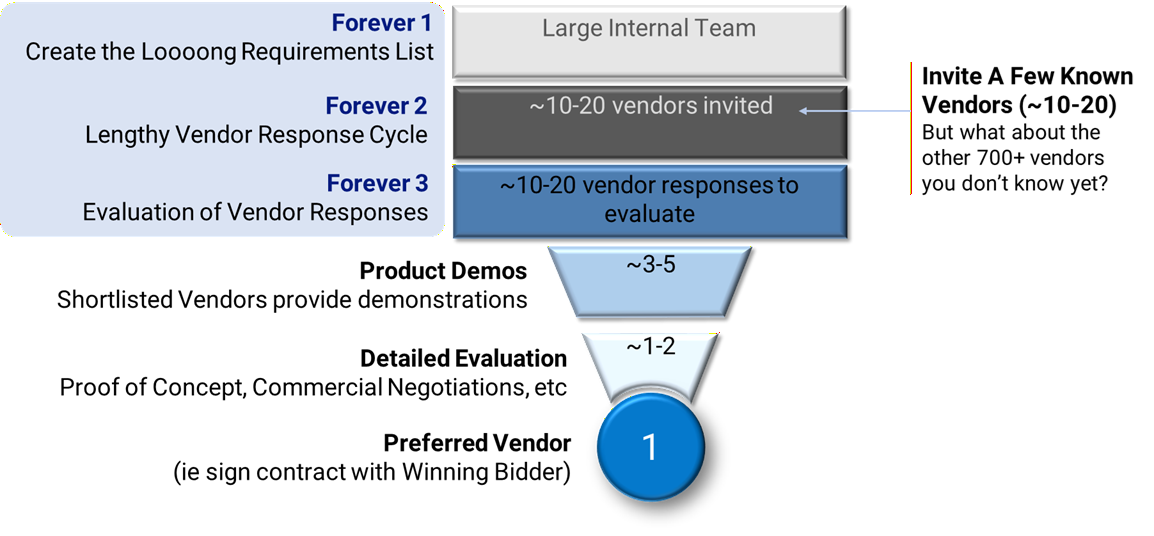
The danger is that the process starts to feel rigorous simply because it’s large. But a large process isn’t automatically a good process. Especially if the process is large, but the list of applicants isn’t comprehensive enough.
Seth Godin’s Red Queen hiring analogy is useful here. He describes runaway selection as organisations competing beyond the point where the activity remains rational. In OSS procurement, the same pattern can appear when buyers keep expanding the process in search of certainty, but end up increasing effort whilst getting further away from a decision.
.
The alternative is to place the rigour where it matters most.
The Inverted Pyramid approach starts broad and inclusive, but then applies rapid filters that hone in on the buyer’s actual needs.
The goal of these early filters is not to evaluate every vendor deeply. The goal is to remove low-fit options quickly and defensibly (leaving a trail of breadcrumbs / evidence for why a vendor was dropped out if any of your colleagues ever ask).
This is an important distinction.
Deep evaluation is expensive. We’ll need deep evaluation, just not yet. Not in Filters 1 and 2 of the PAOSS Inverted Pyramid model anyway.
Proofs of concept, architecture workshops, commercial negotiations, implementation planning and executive alignment all consume serious time from both buyer and seller teams. They should be reserved for vendors that have earned their place on a very specific shortlist of best-fit options.
Start broad enough to avoid blind spots. Filter fast enough to accelerate momentum. Then go deep only when the evidence suggests it’s worthwhile to go deep.
.
A vendor shortlist is not the finish line.
A shortlist that simply names possible vendors (typically 3-5, often very evenly matched), will typically still leave the hard questions unanswered.
This is where the more typical rigourous selection and implementation planning need to connect.
This is also where our other tools (eg RIAT – Rapid Impact Assessment Tool), methodologies and templated implementation patterns become valuable. They help move the conversation from “Which vendor best fits our needs?” to “How do we plan the next steps?”
But those are a story for another day.
If you are embarking on an OSS/BSS vendor selection and transformation, register your interest to have a conversation with us.
