What does a coherent Autonomous Networking transformation plan actually contain?
Are you frustrated that your Autonomous Networking roadmap looks convincing in a boardroom but still isn’t detailed enough to hand to a delivery team?
You’ve established your vision, assessed current and future states, identified capability gaps and prioritised initiatives. Surely you’re ready to start?
But a prioritised roadmap isn’t an executable transformation plan.
Those arrows on a PowerPoint slide don’t tell us who’s doing the work, what it will cost, which dependencies matter or how we’ll know when we’ve succeeded.
The real value of pre-implementation planning is turning those strategic decisions into coherent solution designs, structured work packages and the practical artefacts needed to deliver them.
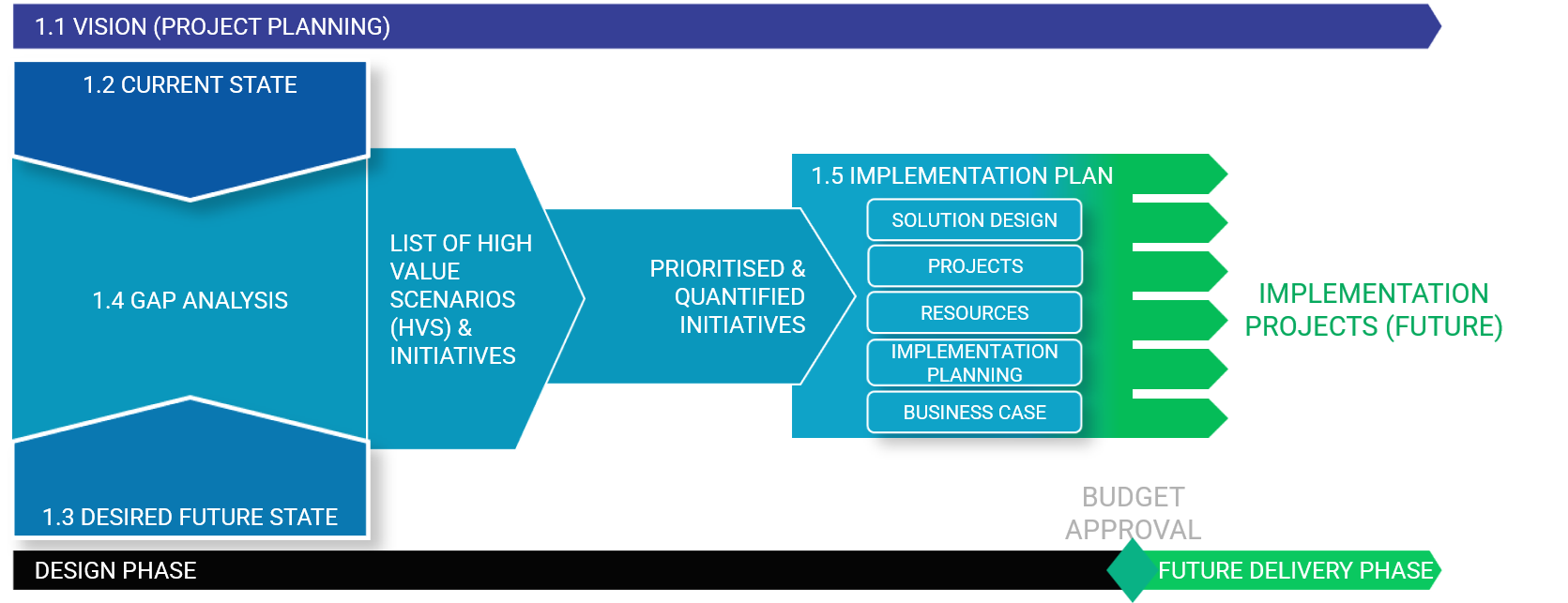
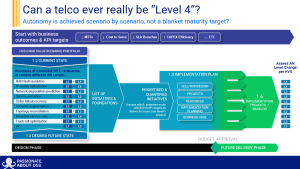
Our AN-specific methodology distinguishes between pre-implementation / designing the transformation (1.1–1.5) [as per the black chevron at the bottom] and delivering it (1.6), supported by ongoing assurance (1.7), as follows:
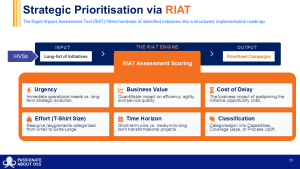
The early stages establish the vision, current state, desired future state and gaps. PAOSS’s Rapid Impact Assessment Tool (RIAT) then helps prioritise the candidate initiatives into implementation campaigns.
But now, how do we ensure that dozens of independently valuable initiatives combine into one coherent transformation?
.
2. Solution design: The connective tissue
Consider an operator wanting to improve RAN fault resolution.
One initiative might introduce AIOps. Another might improve topology accuracy. A third could automate remediation.
Each has merit. But should every initiative have its own data integrations, orchestration logic and AI agents?
Or can we create a design that shares foundations that make the whole transformation simpler and more valuable?
That’s where solution design becomes critical.
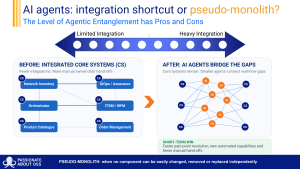
It establishes how initiatives fit together, what capabilities can be reused and which architectural dependencies need to be managed or eliminated. As we explored in article three, individually sensible projects can collectively produce an entangled pseudo-monolith.
We don’t need another architecture methodology. Established approaches such as TOGAF, TM Forum ODA and ETSI ZSM already provide guidance. Insert your own architectural weapon of choice here!!
Naturally, on projects as diverse as OSS/BSS, design techniques will differ between projects.
What matters is that solution designs create programme-wide coherence while providing the technical and operational inputs needed for implementation planning.
.
3. The WBS: Turning designs into delivery artefacts
A Work Breakdown Structure (WBS) decomposes the transformation into deliverables and work packages.
Interestingly, the planning activities in stages 1.1–1.4 are relatively repeatable across transformation programmes.
However, in stage 1.5, solution designs and selected initiatives shape the project-specific implementation work. An inventory replacement, AIOps implementation and AI-agent project will all require different activities.
From this sample WBS above (which you can interact with here), we can develop schedules, resource plans, RACI matrices, business cases, acceptance criteria, test plans and delivery backlogs.
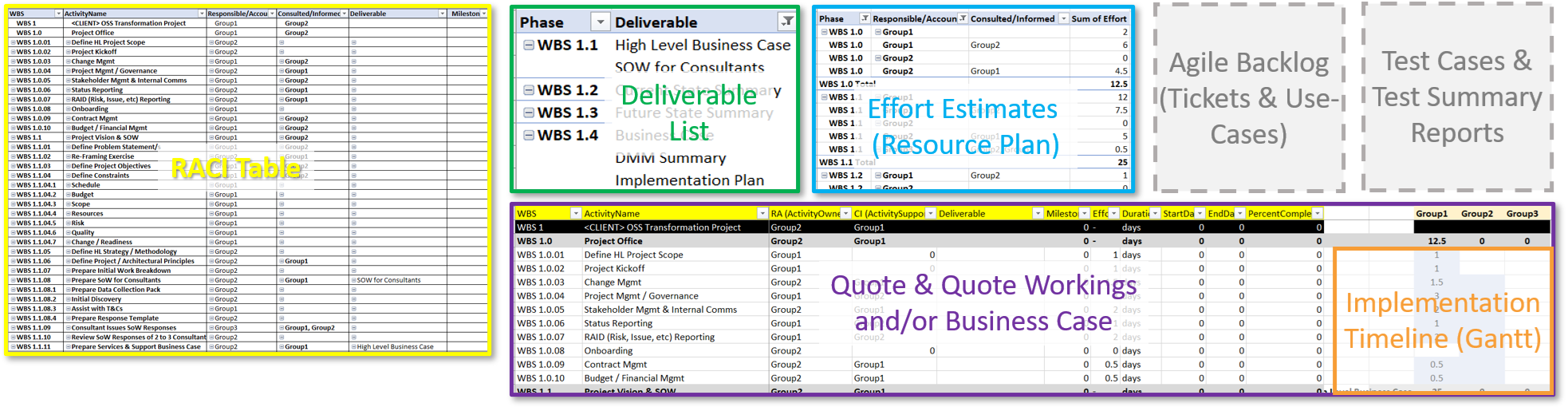
We use the WBS to generate and maintain the following project artefacts:
As follows:
Project backlogs: Jira epics, tickets, user stories, prerequisites, priorities and acceptance criteria
Resource and effort plans: Skills, assignments, estimates and capacity requirements
Implementation schedules: Gantt charts, milestones, dependencies and critical paths
RACI matrices: Clear responsibilities and decision-making accountability
Commercial artefacts: Business cases, cost estimates, quotes and supporting workings
Testing artefacts: Test cases, validation criteria and evidence of completion
Importantly, the WBS doesn’t dictate the delivery methodology. Waterfall, Agile, hybrid and AI-assisted software development (AI-SDLC) approaches can all operate from the same underlying structure.
Individual projects in stage 1.6 can therefore proceed differently and separately without losing programme-wide alignment.
.
4. From implementation to verified outcomes
Of course, delivering a system doesn’t necessarily imply the delivery of business value. (eg an AIOps platform might pass acceptance testing without achieving any of the expected reductions in MTTx.)
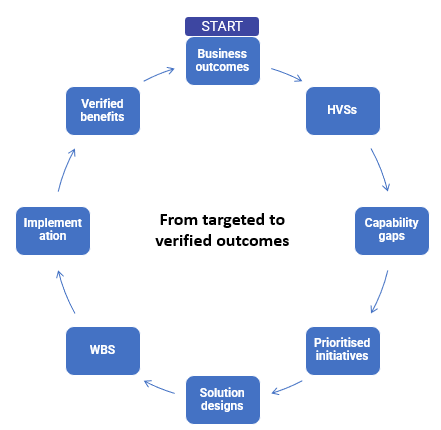
That’s why the transformation must maintain verified benefits traceability:
The result isn’t simply a static roadmap, especially when you’re establishing an Agile backlog. It’s a living plan that connects strategy, architecture, implementation and measurable business outcomes.
.
A practical test for your AN roadmap
Once you’ve done all your implementation planning, choose one prioritised initiative and ask:
Can we trace it from its intended business outcome through solution design, implementation activities, ownership, cost and acceptance criteria?
And does its architecture contribute to the wider transformation without introducing unnecessary complexity?
The real achievement isn’t having an Autonomous Networking strategy. It’s making that strategy executable.
If you found this article useful or valuable, subscribe (in the top-right corner of this page) and share. Let's spread the word and inspire more people to become passionate about OSS.
Ryan is Passionate About OSS and has dedicated the last two decades to sharing his passion for OSS with the world. He is a founder, author, blogger, Engineer, connector and inquisitive learner about OSS and managing networks. To find out a little about his back-story and why he's so Passionate About OSS, click on the About Page. To connect with Ryan and the PAOSS team, click on the Contact page.
If this article was helpful, subscribe to the Passionate About OSS Blog to get each new post sent directly to your inbox. 100% free of charge and free of spam.
Have you aligned your AI, Autonomous Networking and Autonomous Operations (AI/AN/AO) initiatives into one coherent roadmap? You’ve identified the business outcomes, prioritised initiatives using RIAT
How do you decide which of hundreds of potential Autonomous Networking (AN) high-value scenarios (HVSs) deserves your next dollar of investment? Not just HVSs, but
Can you explain to your board exactly what it will get from investing in Autonomous Networking, AI or Autonomous Operations (AI/AN/AO)? Many of the operators
In his book Upstream: The Quest to Solve Problems Before They Happen, Dan Heath tells a fascinating story about homelessness in Rockford, Illinois. For years,