
Eventually, Every Telco AI Project Becomes an OSS/BSS Project
In the first two articles in this “Shadow AI” series, we looked at two problems: fragmented AI investment and the rush across organisations to get

So far in this series, we’ve looked at fragmented AI investment (shadow AI), the rush to get involved in AI, and what happens when those AI initiatives start depending on the OSS and BSS environment.
But there’s another “coherence” challenge as we move from AI that recommends (humans in the loop) to AI that acts (closed-loop).
What happens when multiple intelligent systems are all making seemingly perfectly sensible decisions in isolation at the same time?
This is what we refer to as The Thermostat Analogy.
.
I’d always assumed that more feedback loops meant better control, and faster / smarter / optimal operations. They could all be developed in isolation and voila! Watch the magic happen!
But now let’s pause for a second and imagine two autonomous thermostats controlling the same environment.
Each has its own objective. Each monitors its environmental conditions, makes decisions and takes action. Individually, each may be functioning exactly as designed.
In the diagram below, the heater is trying to raise the temperature of the room to 23oC. Meanwhile the cooler is trying to reduce the temperature to 20oC.
If they operate in isolation and don’t have an awareness of each other’s objectives / actions, they surely end in a battle for control, with both systems competing to try to achieve it’s allotted temperature target. That’s going to get costly if both systems are running full bore without either ever reaching its target!

We’re going to face increasingly sophisticated versions of this problem across AI, Autonomous Networks and Autonomous Operations (AI / AN / AO).
We’re soon going to have not just 2 thermostats but dozens, if not hundreds.
One system may optimise network energy consumption. Another may optimise customer experience. Another may predict capacity requirements. Another may automatically resolve service issues.
Each objective makes sense. But the actions of one can change the environment the others are trying to optimise.
.
This is another reason why we can’t plan every AI / AN / AO initiative independently and assume they’ll fit together later.
The more autonomy we introduce, the more important it becomes to understand shared objectives, dependencies, decision rights, data, actions and potential KPI conflicts.
This is where things get interesting. I don’t think it means designing one central system, or master thermostat, to control all the other thermostats. Not at this stage at least. For a start, many of today’s AI / AN / AO thermostats are black boxes that haven’t been designed to consider external control measures. Also, it might simply be too complex to manage so many conflicting variables in real-time and knowing which thermostat/s should be shut-down if a runaway train event starts to happen.
However, it probably does warrant doing enough combined planning to understand how independently designed capabilities will coexist and potentially conflict.
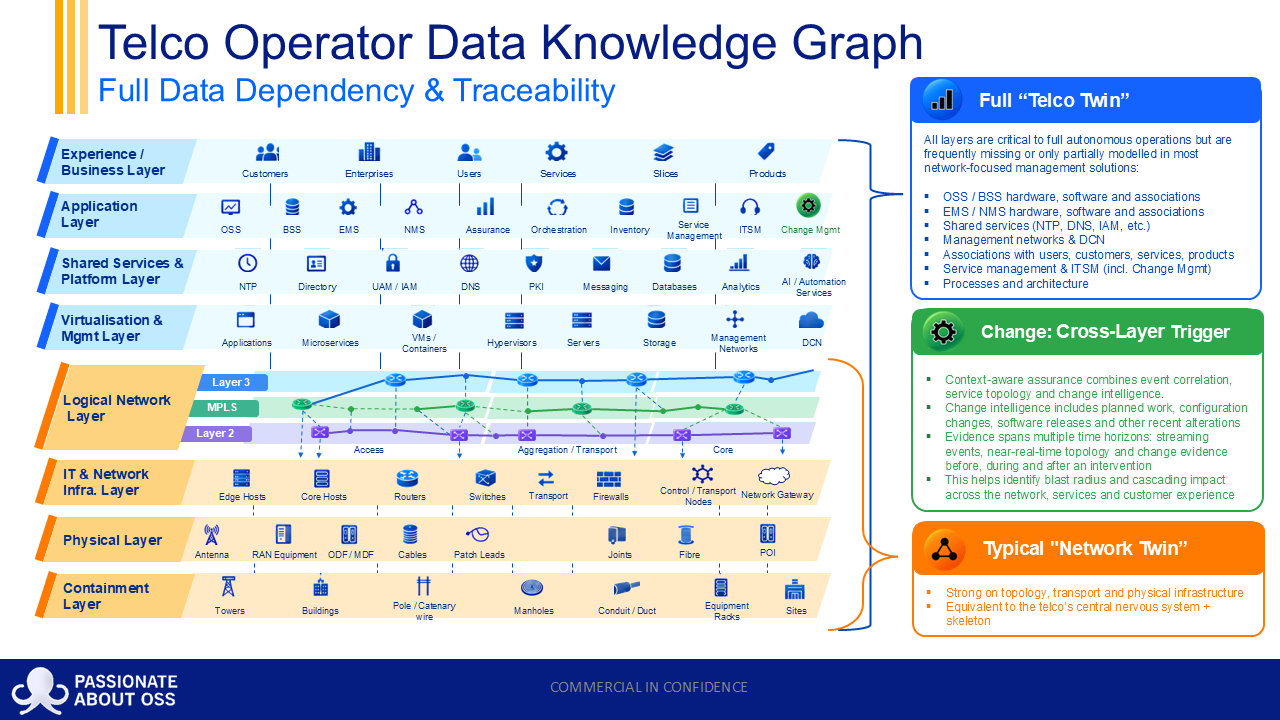
We need to know where local optimisation is safe, where coordination is required and where one system needs awareness of another’s actions. It’s probably another reason why we need a “telco twin” rather than simply a “network twin” as described in this earlier article. One that considers the blue layers, not just the gold layers in the diagram below:
.
Fortunately, we don’t need to invent all of the governance from scratch.
TM Forum‘s AI governance work highlights the need for accountability, audit trails, guardrails and standards as AI is deployed at telecom scale. It already has 80-100 different documents relating to AN (and climbing fast!)
ISO/IEC 42001 provides a management-system framework for governing AI across an organisation.
The NIST AI Risk Management Framework provides another practical approach for identifying and managing AI risks.
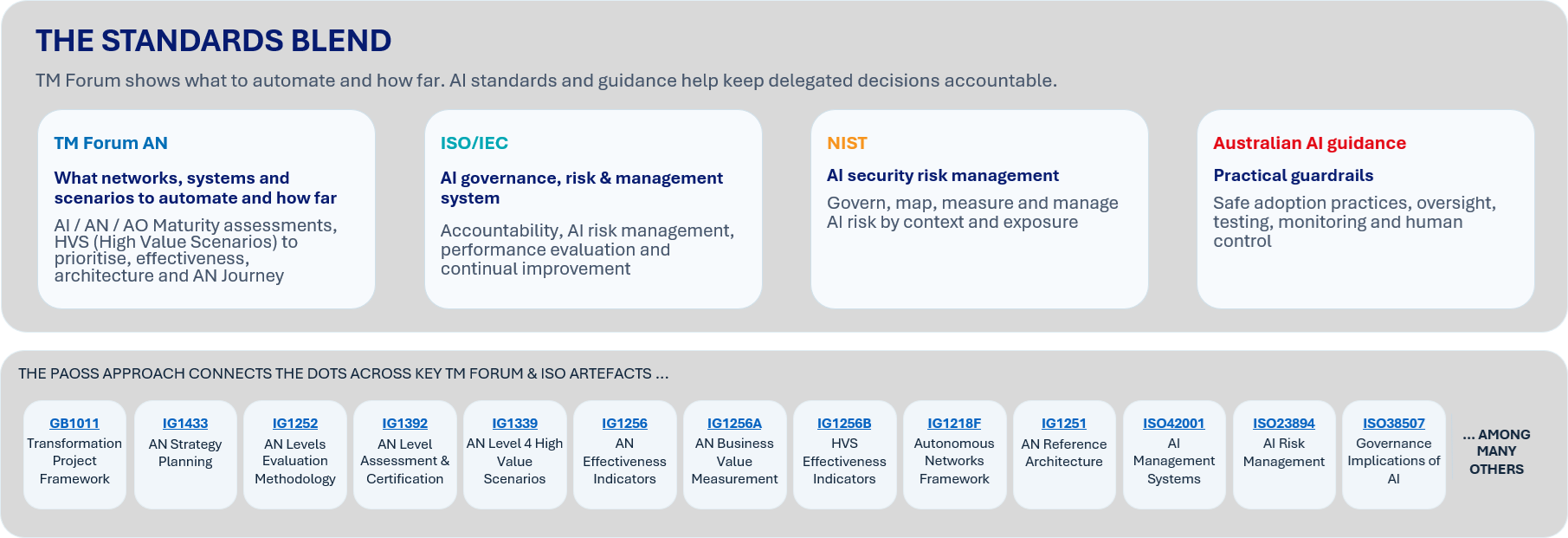
At PAOSS, we’ve incorporated, and continue incorporating, these and related principles into our AI / AN / AO strategy work.
Unfortunately, standards alone won’t solve the thermostat problem.
They can help ensure each system is governed, controlled and operating responsibly. They can’t determine how every independently optimised system should interact within your particular organisation, architecture and operating environment.
That’s a transformation-planning problem. More specifically, an architecture and solution design / planning problem!
Standards can help each thermostat behave responsibly. Combined planning provides the control mechanisms that make sure your specific thermostats aren’t fighting each other.
Which brings us to the final challenge in this series.
If combined planning matters, does that mean AI / AN / AO transformation needs to be centrally controlled?
There are pros and cons for centralised and decentralised (shadow AI), but I don’t think either is ideal. It’s probably some sort of hybrid version.
In the final article, we’ll look at how organisations can create coherence while preserving the freedom, tribal knowledge and local decision-making that make business-unit innovation valuable in the first place.
Download our AI / AN / AO flyer for an overview of the challenges we’re exploring throughout this series. We’ll then consolidate all five perspectives into a practical take-home pack for transformation planning.
