



What Happens when a Software Designer Doesn’t Listen?
What happens when a Software Engineer, Enterprise Architect and Network Ops Engineer walk into a bar?….. . You know that head-slap moment when you realise

According to Russ Hill, IBM had 27 top priorities in the 1990s, and only 3 of them aligned. Telcos today aren’t far off.
The cost?
Misaligned missions and fragmented customer outcomes.
When Lou Gerstner took over IBM in 1993, he found a company with no shortage of smart people or strategies or good intentions. But what he also found was a team pulling in different directions (like the Mercedes Star of our recent article). Each IBM division optimised for different definitions of success, be it revenue, innovation, market share, cost or more. There was no unified view of what winning looked like.
Telcos today face a similar challenge. From engineering to marketing, product to operations, network to strategy, everyone is pulling in different directions. Alignment isn’t just a nice to have. It’s an operational, financial, and cultural problem to deal with.
In this article, we provide five lessons that telcos can take from IBM’s transformation in the 1990s and apply directly to their own environments today.
.
As described in the Mercedes Star article, every telco department has the tendency to see the world, and the telco’s reason for being, in a different light. Network teams obsess over uptime. Marketing over brand metrics. Sales over quota. Strategy over long-term growth. Customer care over churn.
These aren’t just abstract priorities. They’re embedded into systems, particularly the OSS and BSS we’re so passionate about. These platforms don’t just support operations. They support the entire telco business model. They effectively encode each business unit’s worldviews. They define what data is collected, what gets measured, what gets managed and even which information is highlighted more than others.
When OSS/BSS platforms reflect disparate goals, they reinforce division, pulling in different directions like the Mercedes Star below.
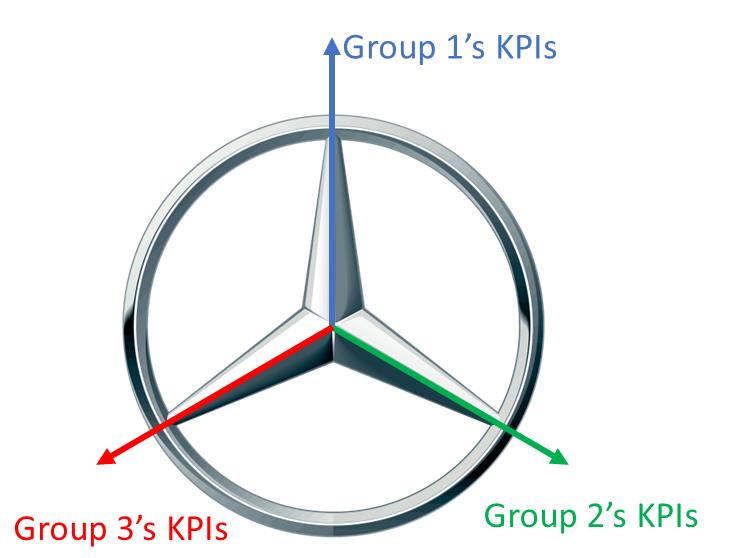
When the KPIs collected by our OSS are carefully aligned to roll up and reflect shared priorities, they become enablers of alignment.
When building these platforms, we need to be aware that they’re the physical collection mechanism of how the organisation thinks. Rather than treating all these KPIs in isolation, we have the opportunity to gather the data in one place and spot misalignments. Fixing KPIs that aren’t unified might be above our pay-grade. We don’t always get to establish the metrics that each business units prioritises. However, the metrics collected by our OSS/BSS can help to easily visualise that red, blue and green are pulling the organisation apart.
.
Misalignment doesn’t just create friction. It drives rework, duplication, and poor customer outcomes. Our OSS/BSS also spot all of this.
It’s common to see engineering teams building long-term capabilities while commercial teams chase short-term revenue. For other use-cases, it could be the exact opposite across the same teams. Product teams ship features they think are useful but sales didn’t ask for or need. Marketing launches campaigns that customer care isn’t prepared to support. All have budgets that are used to drive improvements in their own metrics (even if they impede the metrics of others).
The result? Customers see the results. Internal frustration grows. And performance dips, despite best intentions.
As with IBM in the ’90s, the problem isn’t capability. It’s coordination. Strategy alone doesn’t solve this. A brilliant plan, delivered by misaligned teams, is still indistinguishable from chaos.
.
Gerstner didn’t fix IBM by writing a new strategy. He fixed it by installing a consistent framework.
He mandated one set of priorities. One language. One scorecard. Within months, internal conflicts surfaced. Within a year, IBM began moving as one.
Telcos need similar systems. And what systems collect the data? What systems generate the scorecards? What systems drive the self-corrections and optimisation behaviours?
I bet you can’t guess. Go on. You didn’t suggest OSS and BSS did you?
Beyond rituals, telcos must adopt structured artefacts that make misalignment visible. Three tools help here:
Worldview Alignment Mapping: Use heatmaps to visualise how each function (e.g. CFO, CTO, CMO, COO) perceives transformation outcomes and risks. This allows for early identification of where stakeholder concerns don’t overlap
Stakeholder Prioritisation Matrices: Classify stakeholders by urgency, engagement, and influence. This helps focus effort where alignment matters most, whether you’re selling a solution externally or building consensus internally
Persuasion Checklists: Document every stakeholder’s objectives, expected value and “success markers.” This ensures that the transformation case resonates across all domains, from finance and tech to operations and sales
.
Telcos often blame silos for slow delivery. But silos are natural in large, diverse, geographically-spaced organisations. What’s dangerous is when no one sees how their silo’s priorities clash with others.
The first step in overcoming the misalignment is visibility. Worldview heatmaps are a powerful way to surface the “Mercedes Star” problem, where misalignments quietly kill transformation projects before they start.
Instead, telcos must foster alignment around a North Star: a single strategic objective that every unit can roll up their KPIs toward. If CFOs look at ROIC, operations look at process automation, and sales looks at churn reduction. If carefully designed, all should feed the same productivity and value loop.
When teams begin to see how their success contributes to shared outcomes, friction turns into flow. Budget allocations also seem aligned, where one unit’s spend adds value to others, not detracts from it.
.
What gets measured gets managed / optimised. And if each department has its own scoreboard, they’ll play their own game.
Embracing cascading KPIs that are linked to a unified North Star is not just a theoretical model. Elisa, a Nordic telco, has built exactly this culture. They replaced local optimisation with cascading KPIs that reinforce a top-level goal: sustainable value creation. Every function contributes to that outcome through role-specific but interlinked success markers:
CFO: Return on invested capital, sustainable margin growth
Operations: Automation rates, cycle-time reduction
Commercial: Churn reduction, NPS, revenue per employee
Tech: Network performance tied directly to customer satisfaction
OSS/BSS practitioners may not define these North Stars, but we can encode them via the algorithms we use to transform raw data into insights.
Scorecards and dashboards should not just present data. Generally speaking, Telcos don’t even need more dashboards. What we do need from our dashboards comes in three mechanisms. Clear visibility of goals. How the organisation is tracking against those goals. And perhaps the most commonly overlooked feature is for decision-making to be built in, clear and actionable (highlighting exactly which decision levers must be pulled to optimise for top-level and cascading goals at any time).
.
Gerstner didn’t fix IBM with a better idea. IBM already had lots of clever people with lots of good ideas. Instead he fixed it with one common idea (no more than 3 organisation-wide priorities published publicly) that everyone could act on together.
Many of today’s telcos face the same challenge (and opportunity) that IBM did before Gerstner arrived.

What happens when a Software Engineer, Enterprise Architect and Network Ops Engineer walk into a bar?….. . You know that head-slap moment when you realise

A reader of Mastering Your OSS recently reached out to indicate that he found Chapter 7 useful for understanding OSS-related risks and mitigations. He pointed
Have you ever wondered why there’s such a big deal made of the start of a marriage (there’s a whole industry built around engagements and

Whether we like it or not, most of us judge books by their covers. Sometimes that’s visual. Sometimes it’s the title. But here’s a thing