Daniel Priestley recently highlighted something as important for business owners as telcos seeking out their next OSS or BSS solution:
“If I said to you, go and build your dream house, the first thing you’d do is imagine the finished product. You’d drive around beautiful neighbourhoods, look at the ones you wish you lived in, already finished, already done. You should be doing the same thing for your business.”
It is a powerful idea. Before you build, you look. You study what already works. You walk through completed examples. You notice the materials, the layout, the flow, the trade-offs, the features you love and the ones you would never choose for yourself.
But that poses an interesting question for our industry. How do you do that in OSS?
If you are a network operator, where do you go to look at dozens of “beautiful homes” that have already been built?
In other words, how do you see the full range of OSS solutions and possibilities before you start designing your own transformation?
.
The OSS Market is Full of Finished Houses – But They Are Hard to Find
The OSS landscape is crowded, fragmented, and constantly evolving. There are vendors for inventory, assurance, orchestration, automation, service fulfilment, network planning, field operations, data management, AI, observability, digital twins, integration, and much more.
Some are global platforms. Some are niche specialists. Some are emerging innovators. Some are proven workhorses that quietly support critical operations across the world.
The challenge is not a lack of options. The challenge is knowing which options exist, what they are good at, where they fit, and whether they are right for your specific business.
We often talk about the Car-Yard Analogy for selecting the best OSS for your needs. But there’s an aspect of the “building houses” analogy that works even better for OSS. Most people just buy their cars without making many customisations. House-hunters and OSS buyers are far more likely to request modifications to the base solution (or even design entirely bespoke solutions).
.
This is where the Architect Role Matters
When someone builds a dream house, they rarely start by calling every bricklayer, electrician, window supplier, flooring specialist, and kitchen installer directly. They work with an architect who understands the vision, the constraints, the site, the budget, and the trade-offs.
That is how we see our role in OSS.
We work across the vendor landscape. We engage with the different suppliers. We understand the patterns, overlaps, gaps, strengths, and limitations. Then we help clients shape the best-fit outcome for their needs.
Not the most fashionable, “follow what everyone else is doing” outcome. Not the loudest vendor story. Not the biggest brand by default. The best-fit architecture for each client’s unique strategy, operations, systems, people, and future ambitions / roadmap.
.
Our Vendor Directory Is the Neighbourhood Tour
That is one of the reasons why we created our Blue Book OSS/BSS Vendor Directory.
Think of it as a way to drive around the beautiful neighbourhoods of our industry. It gives you visibility of the vendors and solution providers that are shaping the OSS market. It helps you discover options you may not have known existed. It gives you a broader view before you commit to a direction.
But we don’t just see the baseline products. We also get to see the finished, fully customised, solutions. We get to see how vendors and integrators, and the network operators themselves, tweak and evolve the base products to make them fit their exact needs.
As far as we’re aware, no other company does this in quite the same way.
We’re not just listing suppliers. We’re trying to make the OSS landscape easier to navigate, compare, and understand – to overcome the Buyer-Seller Chasm – so that better decisions can be made earlier.
.
Start with the Finished Picture
The biggest OSS mistakes often happen when organisations start building before they’ve properly imagined the finished product or understood what’s really possible (and viable).
They might select tools before really understanding or defining what outcomes matter most. They might just follow vendor roadmaps before clarifying their own. They might optimise for isolated functions before understanding what really moves the needle towards the operating model they want to create.
Priestley’s quote is a reminder to reverse that thinking.
Look first. Study what exists. Explore the finished homes. Understand the design choices. Seek out expert guidance. Then decide what you want to build.
In OSS, that means looking across the vendor ecosystem before locking in your architecture. It means understanding the market before writing the requirements. It means using an architect who knows the suppliers, the patterns, the possibilities and the pitfalls.
The best OSS outcomes don’t start with software. They start with a clear picture of the business you are trying to build, not just for today but for the 5-10 years into the future when you’ll still be using the solution you’ve purchased.
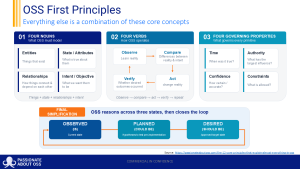
(BTW, this reframing exercise might help figuring that part out).