


Treating telco data quality like homelessness
In his book Upstream: The Quest to Solve Problems Before They Happen, Dan Heath tells a fascinating story about homelessness in Rockford, Illinois. For years,

Can you explain to your board exactly what it will get from investing in Autonomous Networking, AI or Autonomous Operations (AI/AN/AO)?
Many of the operators we speak with are targeting higher Autonomous Networking Level 4 (AN L4) maturity, launching AI pilots and investing in closed-loop automation.
What many technologists fail to recognise is that autonomy isn’t a desired executive outcome. A more autonomous network isn’t necessarily a more profitable, resilient or customer-friendly one.
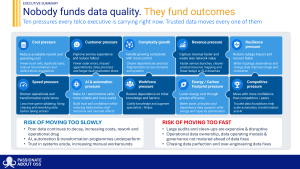
The strongest AN strategies don’t start with AN L4 or autonomy at all. They start with the business outcomes executives are trying to buy such as:
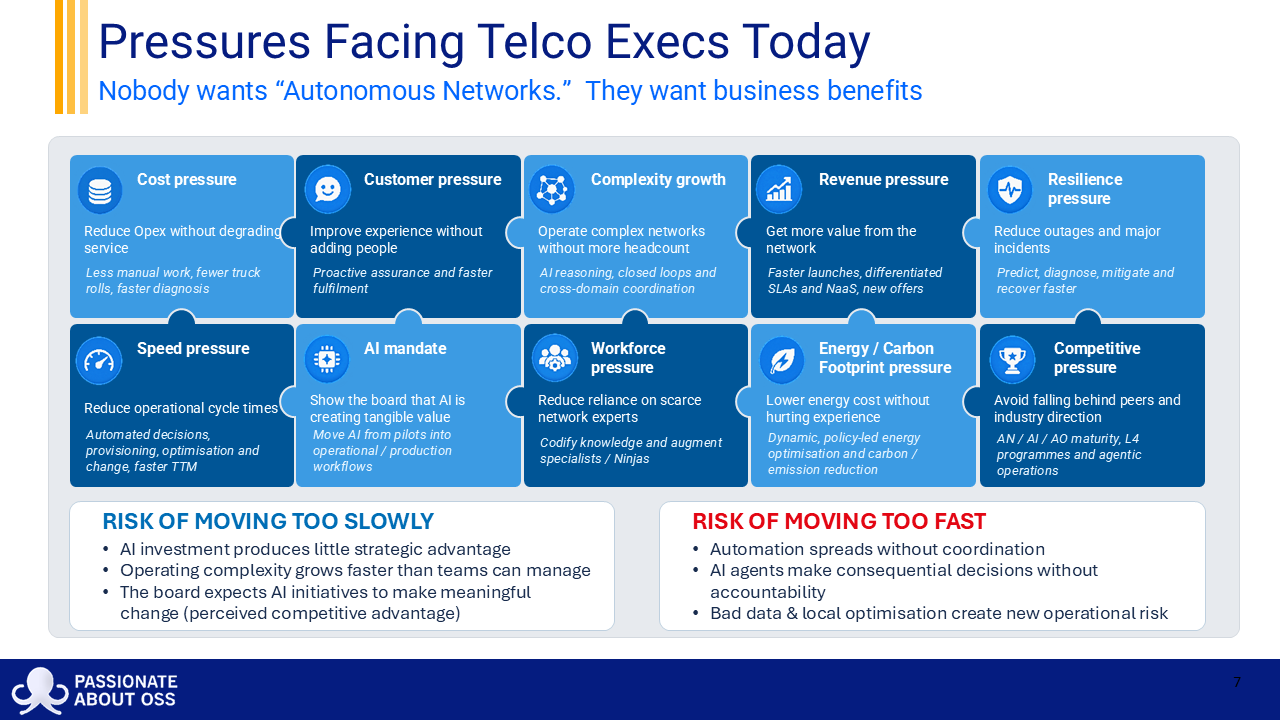
Nobody funds autonomy for its own sake. They fund outcomes.
AI/AN/ AO (AI, Autonomous Networking and Autonomous Operations) are among the mechanisms that can help deliver many of the outcomes in the jigsaw pieces above.
The important question is how to connect the investment in those capabilities to the results the business actually needs. Not just on a single use-case. The industry is generally very good at connecting a single use-case to a measurable outcomes.
The challenge around AI/AN/AO is developing a whole programme of use-cases with coherent, consistent and measurable outcomes.
We’ll cover this in more detail today, but also the series of articles that follow.
Consider the pressures facing telco executives today in the jigsaw puzzle above. These pressures include:
At least, these are the ten pressures we’ve been using at PAOSS to frame Autonomous Networking transformation discussions. You can probably think of others. They’re not all equally important to every operator either, so it’s a case of matching the best-fit mix for each client.
Nor are they necessarily independent. Reducing outages might simultaneously improve customer satisfaction, lower operational costs, free up specialist resources and protect revenue.
In a 2026 TM Forum survey covering 125 respondents across 80 companies, reducing O&M costs, automated fault detection and resolution and improving personnel efficiency were among the leading network operations drivers for AN. Improving customer experience was rated very important by 86% of respondents.
.
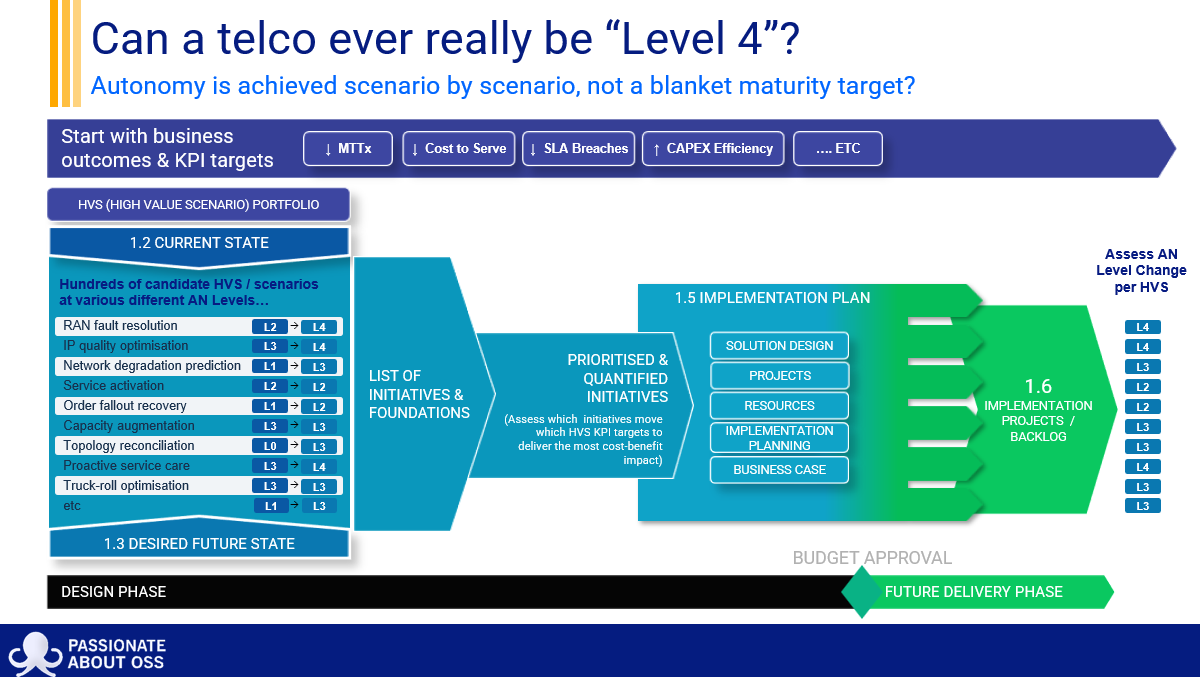
Another interesting consideration is that operators often talk about wanting to achieve AN L4 like it’s a blanket maturity target. The only problem with that is that operators are likely to have different processes at different autonomy levels, so how do you ever roll those up to a single AN Level across the whole organisation (as described in the PAOSS methodology diagram below)?
BTW. It is possible that an operator may choose to target AN L4 for every one of its HVS (High Value Scenarios), but it’s unlikely.
.
Imagine a CTO announces an ambition to reach AN Level 4 (it’s not that hard to imagine as it’s a common catch-cry for the industry at the moment isn’t it?).
But how does the CFO decide, and justify, how much to invest?
Does a move from Level 2 to Level 3 justify a particular budget? Is Level 4 in energy optimisation worth more than Level 3 in service assurance? Which investment should happen first?
The maturity score alone cannot answer those questions.
TM Forum recognises this distinction. Its Autonomous Network Effectiveness Indicators framework, IG1256, measures the effectiveness of AN initiatives against business objectives, complementing the AN Levels taxonomy.
Autonomy measures what a system can do. Business effectiveness measures what that capability actually achieves.
An operator might automate thousands of alarms without materially improving service availability. It might increase the percentage of automatically resolved tickets while leaving recurring faults untouched. Or it might introduce sophisticated AI-assisted diagnostics without reducing the time customers spend without service.
All of those projects might demonstrate technical progress. But have they collectively delivered the business outcome?
This also suggests that we should reverse the normal approach to selecting AI projects.
Instead of asking which AI capabilities we can introduce, start by asking:
In our earlier article, Everyone Wants to do an AI Project, we explored the consequences of widespread AI experimentation.
Next, the opportunity is to give that experimentation a common destination.
.
This is where a practical translation framework becomes useful.
TM Forum’s IG1339 High Value Scenarios work provides an industry reference for identifying and prioritising important AN operational scenarios. IG1256B adds an effectiveness-indicator structure for assessing value within those scenarios.
At PAOSS, we propose connecting these concepts using a Business Outcome-to-HVS Traceability Matrix.
The logic / sequence is straightforward:
Consider how the ten executive pressures might translate into candidate AI / AN / AO initiatives.
| Executive pressure | Desired outcome and example KPI | Candidate scenario | Key enablers |
|---|---|---|---|
| Cost | Lower cost per incident | Automated fault triage and resolution | Event correlation, workflow automation |
| Customer | Fewer service-impacting incidents and repeat contacts | Proactive service assurance | Service inventory, customer impact context |
| Complexity | Fewer manual interventions as networks grow | Cross-domain fault correlation | Trusted topology, common resource identities |
| Revenue | Faster monetisation of differentiated services | Experience-assured service operations | Service models, SLA monitoring |
| Resilience | Reduced customer-impacting outage minutes | Predictive fault detection and recovery | Telemetry, diagnostics, policy controls |
| Speed | Shorter provisioning and change lead times | Intent-driven service fulfilment | Orchestration, workflow integration |
| AI mandate | Verified benefits against approved baselines | AI-assisted operations across priority scenarios | AI governance, measurement, validation |
| Workforce | Fewer escalations requiring scarce specialists | AI-assisted diagnosis and knowledge retrieval | Runbooks, operational knowledge |
| Energy / carbon | Lower energy per unit of traffic without poorer service | Adaptive RAN energy optimisation | Energy telemetry, optimisation policies |
| Competitive | Shorter launch cycles for new offers | Automated activation of assured services | Reusable service models, APIs |
Note: These are candidate scenarios and indicative KPIs, not a reproduction of the official TM Forum IG1339 scenario catalogue. Each operator must establish its own baseline, feasibility and value assumptions.
Let’s take one example further.
Suppose the executive pressure is resilience. The desired outcome is fewer customer-impacting outages. A possible High Value Scenario is predictive service assurance, supported by closed-loop recovery for appropriate fault types.
That scenario might require better alarm correlation, accurate resource-to-service relationships, topology context, service impact analysis, diagnostic intelligence, an orchestration capability and controlled remediation workflows.
Suddenly, the discussion changes.
We’re no longer asking whether to buy (or build) an AI assurance platform. We’re asking which combination of capabilities can reduce customer-impacting outages, which foundations can be reused elsewhere and which implementation sequence will deliver value most effectively.
That provides a much stronger basis for coherent, consistent prioritisation and investment. That’s particularly true when we’re planning an entire programme of work, whereby there are multiple executive pressures, desired outcomes, capability deliveries and target metrics to assess.
.
Here’s where the exercise becomes particularly interesting.
Having mapped the outcomes and scenarios, we may discover that the most valuable next step isn’t an AI, AN or technology investment at all. It could be training, a partnership, collateral development or more.
But even more likely is that precursor or foundations projects like Data Quality Improvement, better governance, a change in Ops Model, or many others might be required before the technology can begin to live up to expectations.
Or perhaps three independently funded AI projects are about to build three slightly different versions of the same capability. Each project might make sense in isolation. Collectively, they might be wasting money. Worse still, they might create unnecessary dependencies between platforms, agents, data stores and workflows. This is what we refer to as the Shadow AI problem.
We’ve explored this architectural risk in Entanglement vs Adaptability and the way AI inevitably draws on operational platforms in Eventually, Every Telco AI Project Becomes an OSS/BSS Project.
The investment planning question is therefore bigger than selecting the highest-value individual AI use cases.
Are our projects collectively building reusable foundations? Are we directing budgets towards the capabilities with the greatest contribution to business outcomes? Can the resulting architecture evolve without becoming increasingly entangled?
These two words – coherence and entanglement – are ones that I find myself using every day at the moment.
The trick is to design and sequence initiatives / projects deliberately, so that early progress contributes to the longer-term programme rather than creating a micro-strangulation of agentic or microservices technical debt that must later be unwound (if it’s even possible to be disentangled).
.
So how do we turn these pressures into a transformation programme?
PAOSS has built an AN Transformation Methodology built around TM Forum’s Transformation Project Framework (TPF) (GB1011).
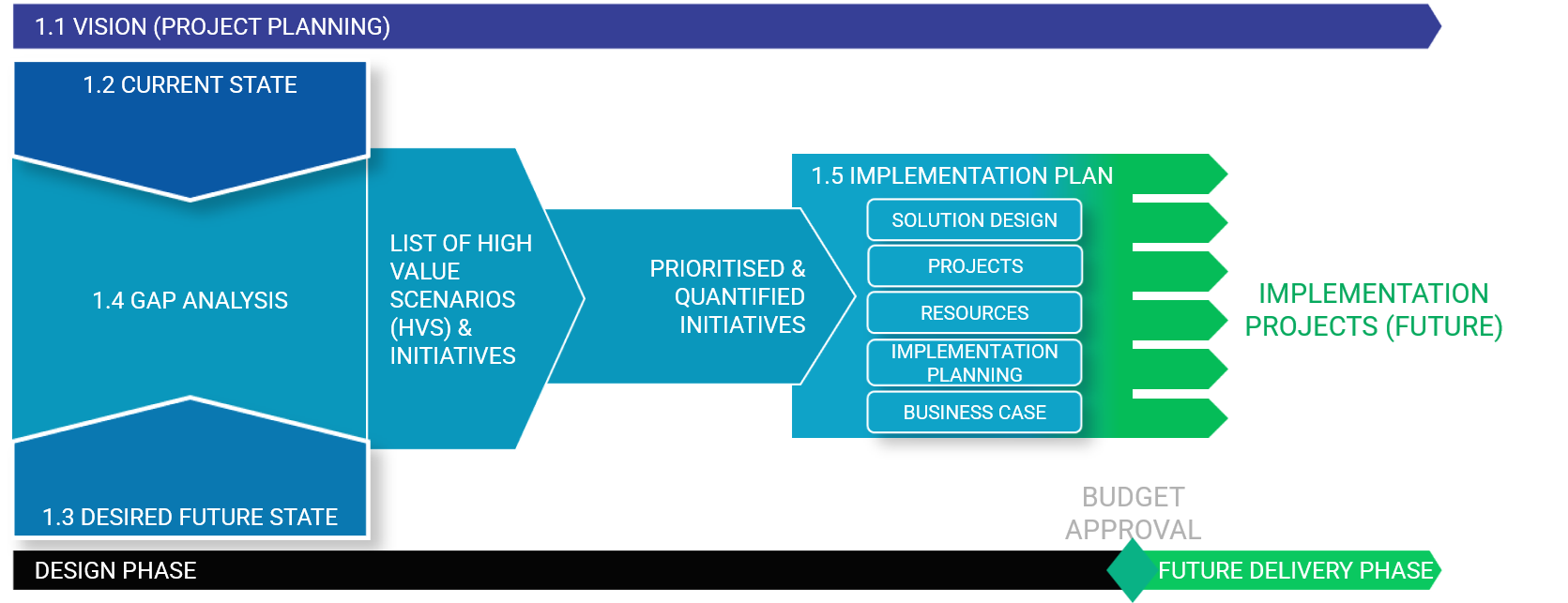
The first step is to establish an agreed executive vision (1.1), with measurable operational and commercial outcomes.
After identifying current (1.2) and desired future states (1.3), we then perform a gap analysis (1.4) that includes identifying the High Value Scenarios and initiatives most likely to deliver big-impact outcomes.
Finally, turn the portfolio into a coherent implementation programme (1.5), with projects, dependencies, resources, costs, responsibilities, delivery plans and measures of success all incorporated.
This approach builds on the Transformation Project Framework we’ve previously described in The Ultimate Framework for Planning Large-Scale OSS Transformations.
For Autonomous Networking, the challenge is particularly important because individual improvements must ultimately operate together across networks, OSS/BSS/NMS/EMS platforms, data, processes and organisational boundaries.
The eventual outcome should be much more than a maturity assessment and a collection of attractive AI use cases.
It should be an executable plan that connects executive objectives to operational capabilities, investments and business results.
Most importantly, it should remain a living plan. As we know, the world of AI / AN / AO is reshaping itself rapidly.
As new capabilities are implemented, the operator should have the tools to easily reassess progress, their autonomous maturity, verify the business outcomes, identify emerging architectural dependencies and adjust the investment portfolio accordingly.
The objective isn’t to reach the highest possible AN maturity level everywhere. It’s to achieve the right level of autonomy, in the right places, for the right business reasons.
In the next article, we’ll explore why even a comprehensive Autonomous Networking maturity assessment is not, by itself, a transformation plan.
.
Autonomous Networking can support an almost unlimited number of benefits – lower operating costs, faster fault resolution, improved service availability, better customer experiences, faster service delivery, energy efficiency and potentially new revenue opportunities. Proving those benefits depend on the operational scenario, implementation quality and ability to measure improvements against a credible baseline.
Not by itself. AN Level 4 describes a level of autonomous capability for specific operational scenarios. It can be an important strategic target, but business outcomes must be assessed separately using measures such as operating cost, resolution time, service availability, customer experience or energy consumption.
Start with the most important business outcomes, identify the operational scenarios that influence them and evaluate their expected value, feasibility, cost and dependencies. Prioritisation should consider both individual project benefits and the reusable capabilities that enable future initiatives.
Yes. Operators can realise meaningful improvements through assisted operations, partial automation and conditional closed-loop capabilities in selected scenarios. The appropriate target depends on the business value, operational risk and cost of achieving additional autonomy.
AI provides capabilities such as prediction, classification, reasoning and decision support. Autonomous Networking applies automation and intelligence to network-related operational scenarios, while Autonomous Operations encompasses a broader set of operational processes and responsibilities. AI can enable autonomy, but effective autonomy also requires trustworthy data, integration, workflows, policies, governance and measurable outcomes.
Before commissioning another AI pilot or setting a new AN maturity target, ask whether your organisation can trace its proposed investments back to specific executive outcomes.
Which business pressure does each initiative address? Which operational scenario will improve? What evidence demonstrates its value? Which shared foundations will it create? And which other initiatives depend on it?
A coherent Autonomous Networking transformation starts by answering those questions, then turns the answers into a practical, fundable implementation plan.
That’s the approach we are developing at Passionate About OSS: connecting AN assessment, business value, capability planning and implementation into one end-to-end transformation methodology.
If your organisation is pursuing AN Level 4 or trying to bring multiple AI and automation initiatives into a coherent programme, we’d be interested in comparing approaches.

In his book Upstream: The Quest to Solve Problems Before They Happen, Dan Heath tells a fascinating story about homelessness in Rockford, Illinois. For years,
Imagine an apartment building with a leaking pipe. Multiple apartment owners keep paying to repair damaged ceilings, carpets and walls. But nobody wants to fund
OSS Sandpit – Inventory Enrichment: Finding the Gaps Before an Outage Does Every inventory is out of date somewhere. A switch goes in during a
Bad OSS data has been quietly draining BAU budgets for decades. But with AI, AIOps and Autonomous Networking (AN), we’re about to discover just how