

You have Hundreds of AN HVSs. Which ones are worth automating?
How do you decide which of hundreds of potential Autonomous Networking (AN) high-value scenarios (HVSs) deserves your next dollar of investment? Not just HVSs, but


Have you aligned your AI, Autonomous Networking and Autonomous Operations (AI/AN/AO) initiatives into one coherent roadmap?
You’ve identified the business outcomes, prioritised initiatives using RIAT and agreed which common foundations everyone should reuse.
But what if that well-coordinated programme is also building the next generation of OSS entanglement?
This is the third article in our Autonomous Networking transformation series. In article one, we focused on executive outcomes. In article two, we looked at how HVS maturity gaps become prioritised initiatives.
Now we tackle a different problem.
How do we make sure those initiatives improve autonomy without making the wider architecture harder to change?
.
A coherent programme aligns initiatives to common business outcomes and shared capabilities. Tick!
But coherence does not automatically mean the architecture remains easy to evolve.
An operator might standardise on a shared AIOps platform, common orchestration and reusable data foundations. That creates consistency and can speed up delivery. Tick!
However, if every new workflow, agent and automation logic becomes dependent on the same proprietary platforms, models, identifiers or decisioning logic, the result may be an increasingly tightly coupled environment that is difficult to change later.
The programme is coherent in business terms, but more entangled in architectural terms.
That is the paradox we need to work around.
.
Imagine a typical telco OSS/BSS environment with existing core systems. Network inventory, AIOps, orchestration, ITSM, order management and other systems already have some integrations, but plenty of operational gaps still require manual swivel-chair activities.
AI agents offer an attractive shortcut.
Rather than replacing those systems or undertaking expensive integration projects, we introduce relatively lightweight agents that bridge the gaps, exchange information and automate workflows.
The short-term results can be impressive. Faster operations, fewer manual hand-offs and new capabilities delivered with relatively little change to the underlying systems.
But there’s a catch.
As more agents are introduced, they create additional dependencies between systems, data models, workflows and even other agents.
Each new connection may make perfect sense individually. Collectively, however, they can create an increasingly entangled architecture.
Eventually, changing an inventory system, replacing an AIOps platform or modifying an orchestration workflow might require changes throughout the agent ecosystem.
That’s when we’ve created a pseudo-monolith: an environment where individual components can no longer be easily modified, removed or replaced independently.
The systems are still technically separate. But operationally, they’ve become inseparable, as described on the right side of the diagram below
That is how a coordinated transformation can slowly become a pseudo-monolith.
.
Here’s another question worth considering.
Are most of our initiatives using AI to connect (and entangle) yesterday’s OSS/BSS systems (the core systems in the diagram above) instead of rethinking how we can modernise and replace those core systems?
Traditional OSS applications typically combine three layers: data, embedded business logic and presentation.
But as we explored in I’ve just been blown away again by another really revolutionary demonstration, AI offers an opportunity to fundamentally rethink that architecture.
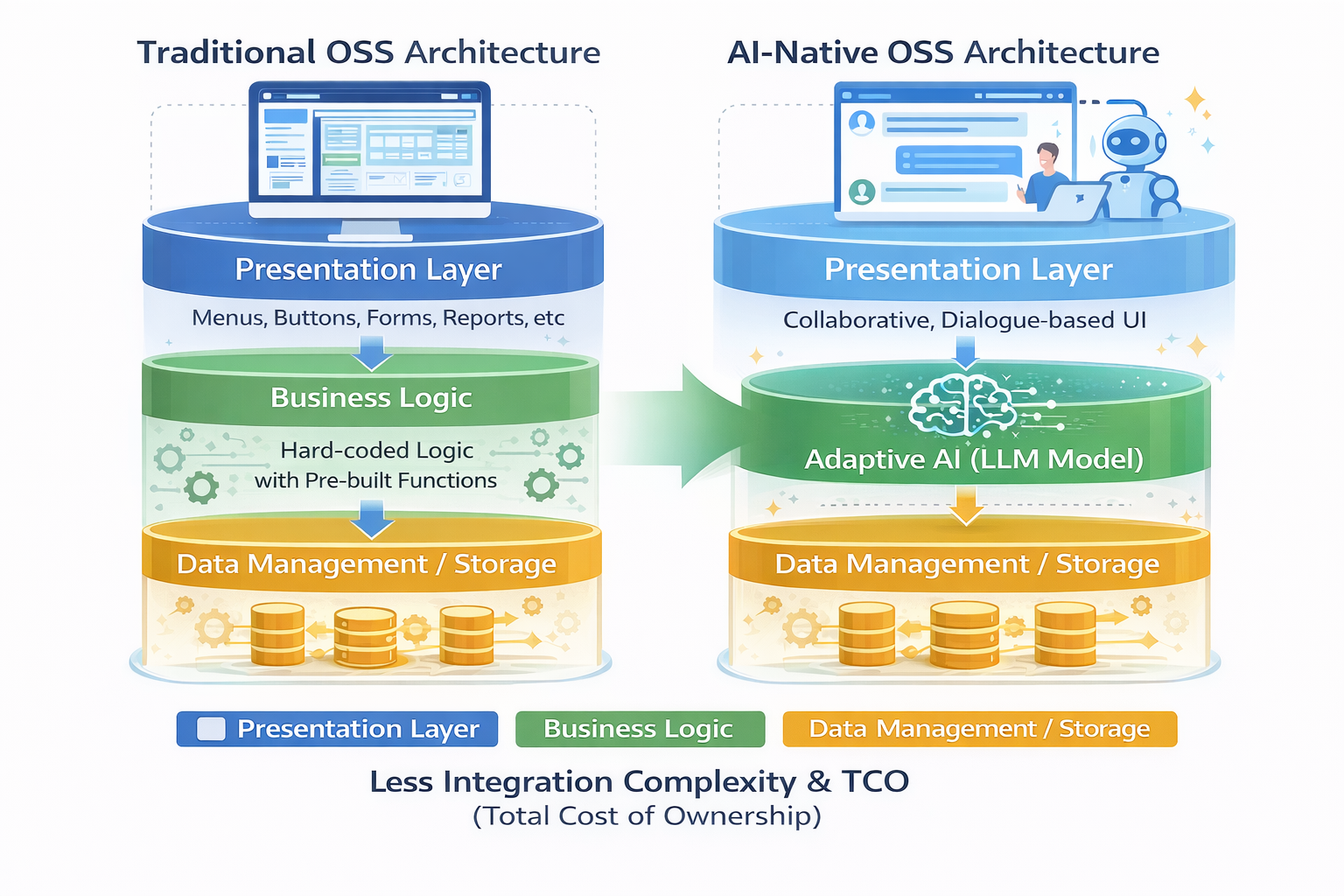
What if we retained trusted data models (the gold layers in the diagram above) and essential deterministic controls, but progressively replaced selected hard-coded, embedded business logic and complex user interfaces with AI-native capabilities?
Rather than perpetually adding agents around legacy systems, we might consider how to eliminate the need for some of those systems altogether.
,.
This suggests two questions we should ask when designing every AI/AN/AO initiative and programme:
These considerations should inform solution architecture and become explicit requirements in the implementation Work Breakdown Structure (WBS), which we’ll discuss more later in this series.
The second part of the paradox is in the delivery of benefits.
Our architectural question instead needs to ask, “what if this agent is deliberately designed as a temporary stepping stone towards an architecture that no longer needs either the integration or some of the underlying legacy functionality?”
Our goal shouldn’t simply be to make yesterday’s core OSS/BSS architecture more autonomous. It should be to build a simpler, more adaptable architecture designed for an AI-native future.
After all, why spend millions making yesterday’s architecture autonomous and inflexible like a monolith if we could also have an eye on building tomorrow’s architecture instead?

How do you decide which of hundreds of potential Autonomous Networking (AN) high-value scenarios (HVSs) deserves your next dollar of investment? Not just HVSs, but
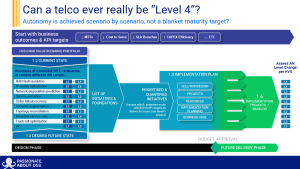
Can you explain to your board exactly what it will get from investing in Autonomous Networking, AI or Autonomous Operations (AI/AN/AO)? Many of the operators
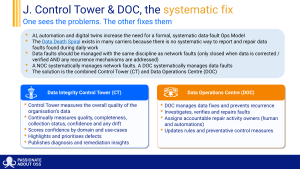
In his book Upstream: The Quest to Solve Problems Before They Happen, Dan Heath tells a fascinating story about homelessness in Rockford, Illinois. For years,
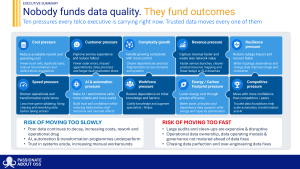
Imagine an apartment building with a leaking pipe. Multiple apartment owners keep paying to repair damaged ceilings, carpets and walls. But nobody wants to fund