


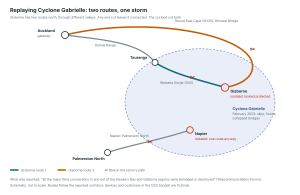
OSS Sandpit – What-If Analysis: Replaying Real Outages on the Network
OSS Sandpit – What-If Analysis: Replaying Real Outages on the Network In February 2023, Cyclone Gabrielle cut every major fibre route into Hawke’s Bay and
Your telco knows enough about you to identify you (via KYC mechanisms), bill you, market to you and manage your services. But does it understand what you’re actually trying to achieve in your digital life? Do they really KYC?
That gap between knowing who a customer is and knowing what matters to them could conceal an entirely new business model. It’s the difference between a telco facing inwards (and achieving commensurately poor NPS scores) and a telco that faces outwards, focusing on the success of its customers.
For more than a century, telecommunications has been removing barriers to communication. We’ve made it possible to connect with almost anyone, almost anywhere, almost instantly. You could argue that that level of accessibility is now problematic in some cases.
We’ve been so successful that we’re now spending increasing amounts of time protecting ourselves from the very connectivity we’ve created. Just think about how carefully we curate the information that reaches us via email, SMS, phone, social media.
What if the next great telco opportunity isn’t about helping customers connect with more of the digital world, but helping them hone in on getting the most out of it?
And what if the answer involves completely rethinking the interpretation of three familiar letters: KYC (Know Your Customer)?
.
From telegraphy to telephony, mobile networks and the internet, telecommunications has relentlessly reduced the cost and difficulty of connecting people.
Today, virtually anyone can communicate with millions of others. AI is making it cheaper and easier still, generating personalised messages and interactions at extraordinary scale.
But herein lies a really uncomfortable consequence. It’s been fascinating to watch the slow swinging of the pendulum from scarcity to abundance in my lifetime in telco… and now I ponder how/when the pendulum begins to inevitably swing back again.
Our digital lives are increasingly cluttered with spam, scams, impersonation, unwanted marketing, content and communications competing for our attention.
We’re building increasingly sophisticated defences to manage the abundance we’ve created. Spam filters, call screening, identity verification and AI assistants are becoming essential tools for navigating the connected world.
Consider a telco that successfully delivers 30 unwanted calls to a customer. From a network perspective, and the bulk outreach agent, that’s excellent service. But does the customer agree?
Perhaps the next major telecommunications innovation won’t be about connecting more people. It might involve deliberately preventing connections customers don’t want.
And for me, that flagged an intriguing question about what it really means to know your customer (KYC).
.
Know Your Customer sounds like a customer-centred philosophy doesn’t it? An outward-facing concept.
In practice, traditional KYC is more of an inward-facing thing for telcos. Something the telcos have been forced to do that they’d probably prefer not to because it’s an additional point of friction between separating a customer from their money.
KYC today primarily helps telcos meet regulatory obligations, establish identities, manage risk and protect themselves against fraud. These activities can benefit customers too, but they’re largely designed around institutional needs (ie inward-facing purposes).
Telcos possess substantial information about their customers. They know what services customers subscribe to, how those services perform and, in some cases, important relationships between identities, devices and network activity.
What if we inverted KYC?
Instead of primarily asking, “Who are you, and what risks do you represent to our business?”, we could also ask, “What matters to you, and how can we help you achieve it?”
But knowing who someone is, or understanding their historical behaviour, isn’t the same as understanding what they actually want, or doing the right thing by them.
As Spiderman’s Uncle Ben suggests, “with great power comes great responsibility.” I’m actually quite proud of the global telco industry’s great responsibility shown with regards to not abusing that customer information… unlike, for example, The Facebook–Cambridge Analytica data scandal, which was a major privacy crisis in 2018. In that case, political consulting firm Cambridge Analytica harvested personal data from up to 87 million Facebook users without their consent
Does enough trust in telcos exist though? Could enough trust exist? Imagine customers voluntarily telling their telco about their interests, aspirations, priorities and boundaries because they genuinely believe it’ll help them.
A customer planning to move house might welcome help discovering suitable utilities, local services or broadband providers. Another might want assistance identifying relevant professional opportunities or managing communications from financial institutions.
This isn’t about exploiting network data to infer increasingly personal details for financial gain. It’s about customers choosing what to share, granting specific permissions and receiving something valuable in return.
Permissions would need to be understandable, adjustable and revocable. Customers would retain control over which organisations or AI agents could act on their behalf, and under what circumstances.
Seth Godin’s concept of permission marketing becomes particularly relevant here. Permission isn’t something businesses acquire through fine print. It’s a privilege earned by consistently delivering value.
There’s also an important distinction between protecting customers and understanding them. Telcos may have privileged capabilities to detect suspicious network activity, but that doesn’t mean customers will automatically trust them as personal advisers.
The KYC inversion isn’t simply about knowing more. It’s fully underpinned by first becoming an organisation whose customers actually want to know them. That confidence is incredibly hard-earned.
.
Fraud prevention offers a credible starting point. A starting point where telcos haven’t traditionally been willing to step up unless coerced by regulators.
Initiatives such as the GSMA’s Open Verifiable Communications are developing frameworks to help customers recognise legitimate business communications. Scam Signal demonstrates how mobile network intelligence can help banks detect potential fraud.
Telcos possess certain network-origin identity signals and preventive capabilities unavailable to ordinary applications or even OTT players.
But network evidence is only part of what could potentially be a more complete trust shield. Cooperation with banks, device manufacturers, identity providers and application platforms is a key pillar. Actively working with banks and security firms to recover fraudulent cash transactions from scammers and extortionists.
Verified identity is limited in isolation. A verified nuisance is still a nuisance.
The more ambitious opportunity involves progressing through five increasingly valuable services:
And that could be a much more compelling reason for customers to engage with their telco.
.
Now, let me also hypothesise about how the KYC inversion might actually be commercially interesting for the telcos.
Telcos have traditionally monetised connectivity / access, subscriptions, capacity and related services. Their ability to connect people remains an essential part of doing business. However, connectivity itself is commoditising so some other form of value-add is necessary.
What if the more valuable product is the trusted relationship rather than the connection carrying it?
This requires a very different perspective to what telco has been built around historically.
This is where I look towards creative thinkers from outside telco:
What possibilities do these concepts open up?
What if the next great telco product isn’t connectivity, customer data, digital identity or even trust – but helping customers achieve things they couldn’t otherwise (or easily) achieve on their own?
Or, what if the next generation of telco growth comes from deliberately doing less of the things the industry has traditionally been incentivised to do?
Here are a few unconventional thoughts:
1. What if KYC applied to businesses wanting to reach customers, with telcos as match-makers
Today, customers must prove who they are to telcos with KYC. What if organisations also had to demonstrate why they deserve access to customers? Not just prove their identity, but declare their intentions, accept accountability and establish that the interaction is welcome. Perhaps commercial senders could even stake a refundable bond against misleading communications.
The inversion: The KYC compliance burden moves towards those seeking attention, rather than those trying to protect it.
2. What if telcos organised customers into group buying power?
Instead of businesses purchasing access to customers, imagine 10,000 customers independently expressing an intention to switch energy providers. Their trusted advocates could aggregate that demand anonymously, negotiate collectively and invite providers to compete for the opportunity.
The inversion: Rather than aggregating customer attention for advertisers, telcos aggregate customer purchasing power for customers.
3. What if businesses paid telcos to help them contact fewer people?
Businesses spend substantial resources trying to reach potential customers who aren’t interested or aren’t currently in a position to buy. What if operators offered an enterprise service that reduced wasted outreach by recognising customer-permitted contact preferences without revealing personal details?
The inversion: A communications company adds value to subscribers (and makes them less likely to churn regardless of ARPU) by match-making buyers with sellers, whilst reducing unnecessary communication.
.
There’s a substantial operational challenge hiding inside this proposition.
Traditional OSS/BSS is predominantly designed to manage products, subscriptions, services, network resources, performance and charging. To serve the needs of an inward-facing telco.
It understands what customers buy, which services they consume and how those services perform.
But an outward-facing / advocacy business needs to understand something quite different.
What does the customer want? What have they authorised? Which relationships are trustworthy? Who may act on their behalf? What happened, and was the outcome valuable?
OSS/BSS have the data to generate those insights…. they’ve just never been asked to (have they?)
They just aren’t the primary questions around which traditional OSS/BSS have been designed to answer.
Clearly, technology alone won’t establish the necessary trust though.
Operators would need transparent governance, safeguards against commercial conflicts, reliable privacy controls and demonstrable customer benefits.
Telcos clearly have to create value long before receiving value in return. They must create trust before receiving trust in return.
Does it start by becoming a clear beacon of protection for their clients without being obligated to due to regulations?
Does it begin with doing the basics – such as verified important calls or cross-channel scam prevention – brilliantly well. Or measuring prevented losses, reducing unwanted interruptions, successful delivery of legitimate communications and customer confidence.
Then test whether customers voluntarily grant permission for increasingly personalised filtering, discovery and advocacy.
Only expand when the benefits, trust and commercial demand are being acknowledged by customers.
.
The first great achievement of telecommunications was making everyone in the world reachable. It increased value in a world that started from a position of scarcity.
In the new world of communications abundance, value might come from limiting reachability.
The KYC inversion offers a provocative possibility: something the telco world has largely treated as a regulatory obligation could become the willing foundation of an entirely new business model.
But owning networks, spectrum and customer databases doesn’t automatically give telcos the right to become trusted advocates. That’s something customers must willingly grant.
The question isn’t whether telcos possess the technology to become trusted. It’s whether they can become organisations customers genuinely trust to act in their interests.
Can an industry that has spent its existence monetising access reinvent itself around the much more valuable privilege of being trusted?

OSS Sandpit – What-If Analysis: Replaying Real Outages on the Network In February 2023, Cyclone Gabrielle cut every major fibre route into Hawke’s Bay and
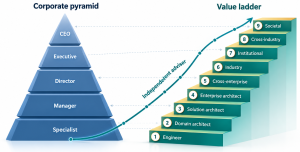
Have you ever looked at the next rung of the corporate ladder and wondered whether that’s actually a job you’d want to do? When I
OSS Sandpit – Hidden Single Points of Failure: Routes That Look Diverse but Aren’t Ask any network planner whether their important sites are protected and
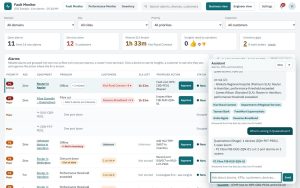
Every NOC has lived this moment. The alarm list lights up, dozens of red rows appear at once, and the first question from the duty