


Telco executives don’t want Autonomous Networks. What do they actually want?
Can you explain to your board exactly what it will get from investing in Autonomous Networking, AI or Autonomous Operations (AI/AN/AO)? Many of the operators


How do you decide which of hundreds of potential Autonomous Networking (AN) high-value scenarios (HVSs) deserves your next dollar of investment? Not just HVSs, but how do you decide which other initiatives, projects and programmes are funded too?
You could assess each scenario’s current AN maturity, identify the gaps and build a programme to close them.
But that assumes every maturity gap is worth closing.
The most useful output of an Autonomous Networking maturity assessment might not be the improvements it recommends. It might be the hundreds of improvements you decide not to fund.
Because reaching AN Level 4 everywhere isn’t necessarily the objective. Delivering business outcomes is.
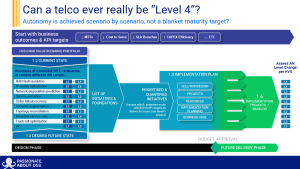
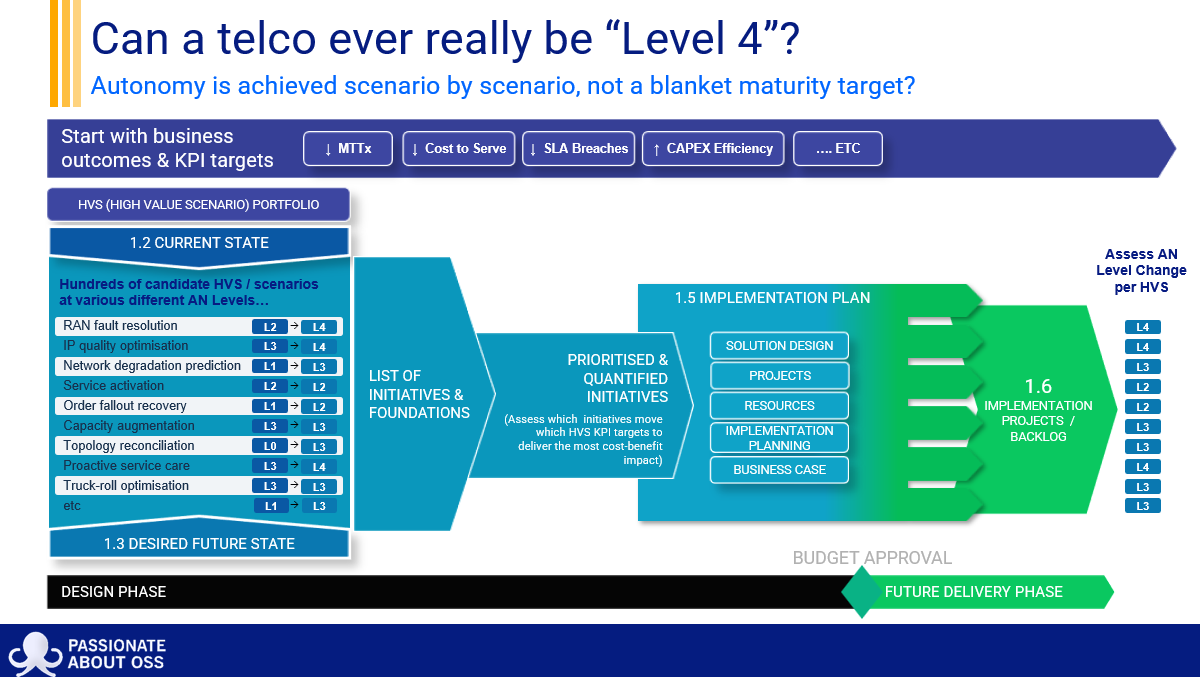
As you see down the left-hand side in the diagram below, the “Service Activation” HVS has a current state and future state of L2. In other words, in this example, it has been decided that there’s no practical reason for making service activation more autonomous than it is today (remember, the example below is just that – an example). Therefore, we don’t need to identify any initiatives that aim to uplift Service Activation from L2 to the blanket L4 target.
This is the second article in our Autonomous Networking transformation series. In the first, Telco executives don’t want Autonomous Networks, we explored why telco executives don’t really want Autonomous Networks for their own sake. They want lower costs, greater resilience, better customer experiences and other measurable outcomes.
But with potentially hundreds of operational scenarios at different current and target maturity levels, how do we decide where to invest? How do we prioritise effort and investment?
.
Operators often announce ambitions to reach AN Level 4. But what does that mean for an entire organisation?
A telco might be highly autonomous in RAN energy optimisation, moderately autonomous in IP fault management and largely manual in service activation.
Different processes. Different maturity levels. Different business priorities.
TM Forum’s AN Levels Evaluation Methodology (IG1252) and ANLET (GB1059) provide ways to assess autonomy in defined scenarios. Meanwhile, the Autonomous Operations Maturity Model (AOMM) addresses broader organisational capabilities.
These are complementary perspectives, not interchangeable scores.
We’ve previously explored the distinction in AN Level 4 is Like Putting a Man on the Moon.
But here’s the question that interests me more.
If we assess hundreds of scenarios and discover hundreds of opportunities for greater autonomy, should we fund all of them?
Almost certainly not.
So this leads to the next step in the process – prioritising which of the long list (often hundreds) of initiatives are worth funding?
.
Imagine two operational scenarios:
Which deserves more investment?
We simply don’t know (yet).
The first might be a low-impact process that is only invoked a couple of times a year and works perfectly well with human intervention. The second might affect millions of customers, with even a modest improvement delivering substantial savings or fewer outages delivering a large uplift in customer satisfaction..
The size of the maturity gap tells us how far we could improve. It doesn’t tell us whether we should.
TM Forum’s Autonomous Network Effectiveness Indicators (IG1256) and HVS Effectiveness Indicators (IG1256B) help distinguish autonomous capability from business effectiveness.
But prioritisation must also consider implementation cost, feasibility, risk, dependencies and benefits shared across multiple scenarios.
A small maturity improvement in a critical process could be more valuable than a dramatic uplift elsewhere.
So how do we make those decisions systematically?
Let me introduce you to…..
At PAOSS, we approach this slightly differently from simply ranking High Value Scenarios (HVSs) by their maturity gaps.
We start by identifying the gap between the current and desired AN Level for each relevant HVS, using approaches such as TM Forum’s High Value Scenarios guidance (IG1339).
Then we turn each gap into a long-list of potential initiatives that could close it.
For example, suppose “RAN fault resolution” is currently operating at Level 2, with a desired target of Level 4.
There might be numerous ways to achieve that uplift, including:
These are potential initiatives, not necessarily projects that should all be funded.
Across dozens / hundreds of HVSs, the resulting long-list could contain hundreds (or possibly even thousands) of candidate initiatives, which potentially include overlapping requirements and shared foundations.
This is where our Rapid Impact Assessment Tool (RIAT) comes in.
RIAT evaluates the candidate initiatives against six typical factors as shown in the orange box below:
Note that we may even adapt the factors, weightings and visualisations to suit the specific needs and priorities of each client.
For our RAN fault resolution example above, the RIAT might show that remediation scripting offers an attractive near-term improvement, while a new AIOps platform requires a larger investment and longer implementation period.
It might also reveal that improving topology data would enable several other high-priority HVSs, making that foundational initiative more valuable than its standalone business case suggests.
The resulting assessments help us group and sequence the most compelling initiatives into prioritised implementation campaigns or projects (or even programmes).
We don’t simply prioritise the biggest maturity gaps. We identify the initiatives that will deliver the greatest business impact, then organise them into a coherent transformation roadmap.
.
Now the really interesting part.
Suppose several prioritised scenarios depend on accurate network topology and resource-to-service relationships.
Do we fund separate data improvement activities within each scenario?
Or would one shared foundation deliver greater value across the portfolio?
This is where assessing initiatives collectively through and after the RIAT becomes particularly valuable.
An inventory integrity initiative might not directly increase any scenario’s AN Level. Yet it could enable several high-value automation projects and reduce the cost of implementing each one.
An initiative with modest standalone benefits can become a priority because of the value it unlocks elsewhere.
We explored the danger of disconnected investments in Everyone Wants to do an AI Project and the architectural consequences in Entanglement vs Adaptability.
This brings us back to two concepts central to our AN Transformation Methodology:
RIAT provides a structured basis for assessing and comparing initiatives. Our broader transformation planning then considers how they fit together.
Otherwise, we risk funding individually successful projects that collectively make the wider OSS architecture harder to manage.
.
By the time we’ve completed our maturity assessments and RIAT prioritisation, we should understand which initiatives offer the greatest business impact, which HVSs they support and how they contribute to the desired autonomy uplift.
But an HVS isn’t necessarily a project.
One HVS might generate several candidate initiatives. Conversely, one initiative could address capability gaps shared by multiple HVSs.
The final step is to connect everything together in the Implementation Plan (1.5 in the diagram below):
This becomes an input to the PAOSS AN Transformation Methodology, building on the approach described in our Ultimate Framework for Planning Large-Scale OSS Transformations.
It also needs continuous reassessment. As technology advances, foundations improve and business priorities change, previously unattractive initiatives might become worthwhile investments.
AN maturity assessments tell us where we are. RIAT helps us decide which initiatives are worth investing in to get where we want to be.
And that distinction could save operators a great deal of money and effort.
AN Levels are assessed against defined operational scenarios, which may have very different maturity levels. An enterprise-wide ambition can be useful, but it shouldn’t imply uniform autonomy across every process.
No. The appropriate target depends on business value, technical feasibility, operational risk and cost. Level 2 or 3 may be entirely sufficient for some scenarios.
We identify HVS maturity gaps, translate them into candidate initiatives and assess those initiatives using RIAT (the Rapid Impact Assessment Tool). The results inform prioritised implementation campaigns, considering business value, urgency, cost of delay, effort, time horizon and initiative classification.
If you’ve already completed an AN maturity assessment, don’t automatically turn every identified gap into a project.
First identify the initiatives that could close those gaps, then assess which offer the greatest business impact and how they might contribute to a coherent transformation programme.
Because the best AN transformation isn’t necessarily the one that automates the most. It’s the one that makes the right investments count.

Can you explain to your board exactly what it will get from investing in Autonomous Networking, AI or Autonomous Operations (AI/AN/AO)? Many of the operators
In his book Upstream: The Quest to Solve Problems Before They Happen, Dan Heath tells a fascinating story about homelessness in Rockford, Illinois. For years,
Imagine an apartment building with a leaking pipe. Multiple apartment owners keep paying to repair damaged ceilings, carpets and walls. But nobody wants to fund
OSS Sandpit – Inventory Enrichment: Finding the Gaps Before an Outage Does Every inventory is out of date somewhere. A switch goes in during a