


OSS Sandpit – Hidden Single Points of Failure: Routes That Look Diverse but Aren’t
OSS Sandpit – Hidden Single Points of Failure: Routes That Look Diverse but Aren’t Ask any network planner whether their important sites are protected and

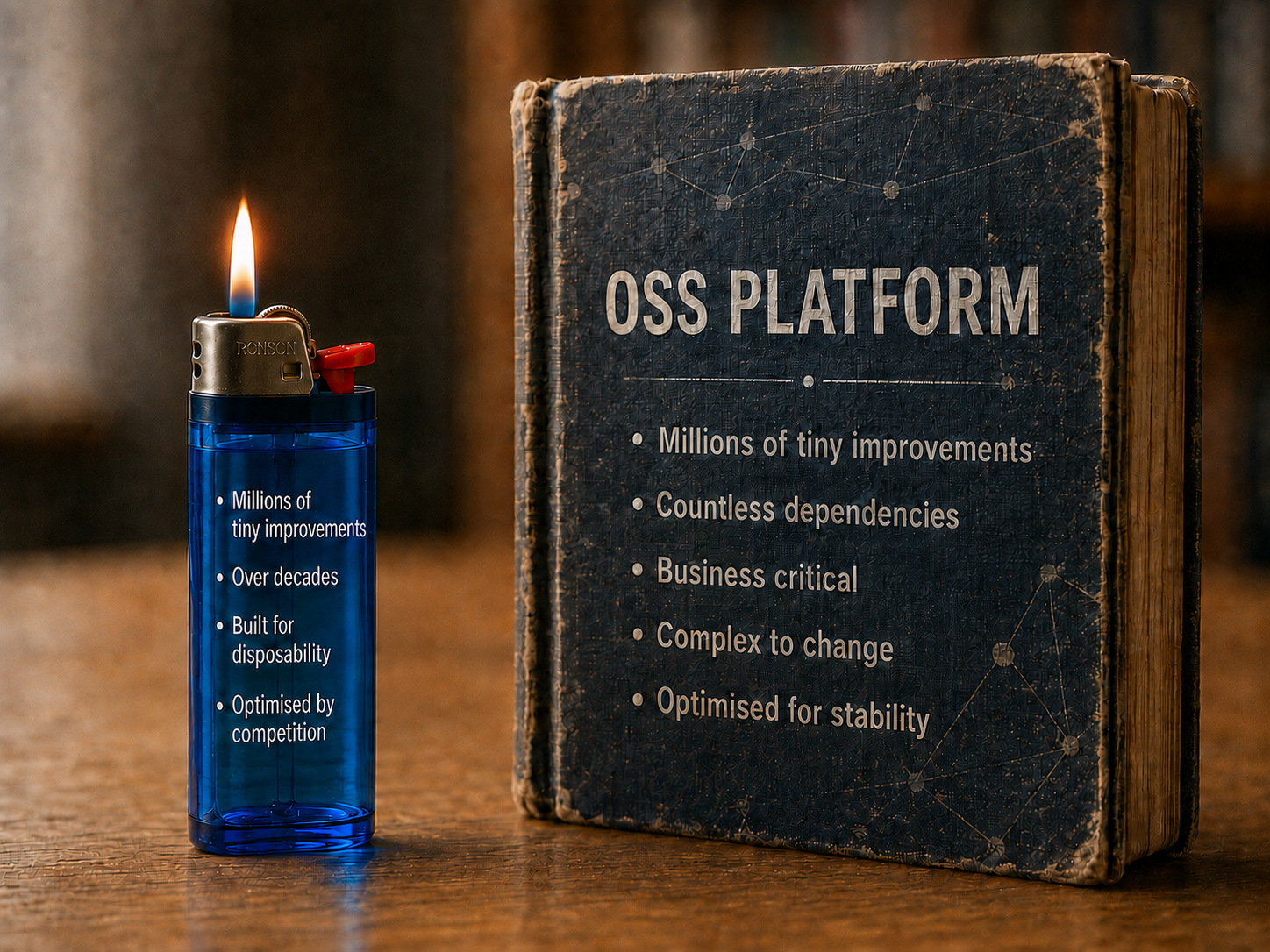
As Daniel Priestley articulates well here, the disposable lighter is an extraordinary example of capitalism doing what capitalism does best – thousands of tiny improvements compounded over decades.
A lighter can be manufactured, shipped and sold for almost nothing because decades of competition have relentlessly squeezed inefficiency out of the system.
Yet OSS/BSS seems strangely resistant to the same market forces, despite competition across hundreds of suppliers. You could even argue that more has been spent on OSS/BSS research and development than on disposable lighter innovations.
Why has OSS/BSS been so frustratingly resistant?
The answer may have less to do with the quality of the products themselves, and more to do with the market mechanisms surrounding them.
We’ve spent the last 25+ years looking at how to unlock the multitude of constraints facing the OSS/BSS / telco industry. This article shares some of what we’ve learned and tips for what you can do to overcome the resistance.
.
Competitive markets work because buyers can choose.
If one lighter manufacturer produces something cheaper, safer or more reliable, customers can switch almost instantly. That mobility allows competitors to quickly respond. Tiny improvements compound, inefficient suppliers or products disappear and the whole market becomes progressively better.
OSS/BSS looks competitive on the surface. There are hundreds of vendors offering billing, assurance, inventory, orchestration, fulfilment, customer management and other capabilities. Being software-based makes them ideally suited to making thousands of tiny improvements to compound, making each OSS progressively better.
But the presence of competitors alone does not necessarily create efficient OSS/BSS competition.
The switching cost and speed is a second component of the free market model.
Buyers need to be able to discover the alternatives, understand them, evaluate them with confidence and, crucially, move between them for it to work optimally.
That’s where the OSS/BSS market behaves very differently from disposable lighters.
The switching cost of a lighter is effectively zero. They’re replaced regularly and seamlessly. By contrast, the switching cost of a deeply embedded OSS or BSS platform can involve millions of dollars, years of effort and substantial operational risk. You can’t just walk up to a supermarket counter, pay $0.50 and light up a new OSS.
But complexity and effort combine to only form one part of the switching constraint.
When the consequences of getting a change wrong are significant, staying with the known incumbent can be an entirely human-factor decision – even when better products exist elsewhere.
.
This can partly be explained as a consequence of what we describe as entanglement.
An OSS/BSS product rarely remains a standalone product for long.
It becomes connected to infrastructure, data sources, workflows, customer journeys and dozens or hundreds of surrounding applications. Business processes evolve around it. Customisations accumulate. People develop years of operational knowledge about its quirks and exceptions.
The longer it remains in place, the more entangled it typically becomes.
This creates an unusual economic moat.
A challenger is not simply competing against the incumbent software. It’s competing against perhaps 10, 15 or 20 years of accumulated entanglement.
That helps explain why the licence price of a replacement product can be almost irrelevant to the true switching decision. The bigger cost can be unwinding the existing entanglement – integrations, data, process, knowledge and organisational change – and then creating a new operating environment.
In other words, the incumbent’s strongest advantage may not be the superiority of its product. It may simply be how deeply it has become embedded.
.
At PAOSS, we’ve helped Buyers and Sellers make thousands of incremental improvements to their OSS tools, processes, transformations, designs, etc.
But as we’ve described in the OSS/BSS Buyer-Seller Chasm series, our most important contribution to the industry is centred around our efforts to reduce switching costs – to help build bridges across the chasm – helping buyers to find, assess / compare and move between alternatives.

On one side, buyers are trying to navigate hundreds of potential suppliers. They need to determine who is relevant, compare capabilities, establish trust and develop enough confidence to contemplate change.
On the other, sellers invest heavily in questionnaires, RFP responses, demonstrations, workshops and sales activity without knowing whether an opportunity is genuinely winnable.
Given a typical vendor selection takes 18-24 months, both sides incur substantial cost simply trying to determine whether they should work together. It’s this combined cost of sale that we’re seeking to slash because all of those costs end up being borne by the telco industry.
Buyers fear selecting the wrong solution. Sellers fear investing too much in opportunities they will never win. Traditional procurement processes can amplify the problem by requiring enormous effort from both sides before either has established whether they’re even a good match.
This creates costly inertia before a transformation programme has even begun.
.
OSS/BSS vendors already spend enormous amounts improving their products. But what if we applied the same optimisation mindset to the mechanisms that connect buyers and sellers?
That’s something PAOSS has spent years attempting to do.
The objective isn’t to pretend OSS/BSS can become as easy to replace as a disposable lighter. Much of the complexity is real and unavoidable.
Instead, we’re constantly experimenting with new ways to reduce the avoidable friction on both sides of the buyer-seller chasm, including (but far from limited to):
None of these approaches eliminates the inherent complexity of OSS/BSS. However, they do attempt to remove unnecessary friction around discovery, matching, evaluation, confidence and implementation planning.
The disposable lighter became extraordinarily efficient because competition could flow through the market with almost no resistance.
OSS/BSS will never be that simple. Clearly, the opportunity isn’t to make OSS/BSS disposable. But our promise is that PAOSS will continue to strive to make the market around these brilliant, enduring, entangled systems work much more efficiently.

OSS Sandpit – Hidden Single Points of Failure: Routes That Look Diverse but Aren’t Ask any network planner whether their important sites are protected and
Every NOC has lived this moment. The alarm list lights up, dozens of red rows appear at once, and the first question from the duty

Across this series, we’ve looked at fragmented AI investment, the rush to launch AI projects, the AI dependence on OSS and BSS, and the need
So far in this series, we’ve looked at fragmented AI investment (shadow AI), the rush to get involved in AI, and what happens when those